2026-09-09
Health and Beauty Retail Hoarding Graphics: Color Accuracy, Brand Compliance, and Turnaround Times
By Bryce Mitchell — Founder, Rapid Retail Graphics
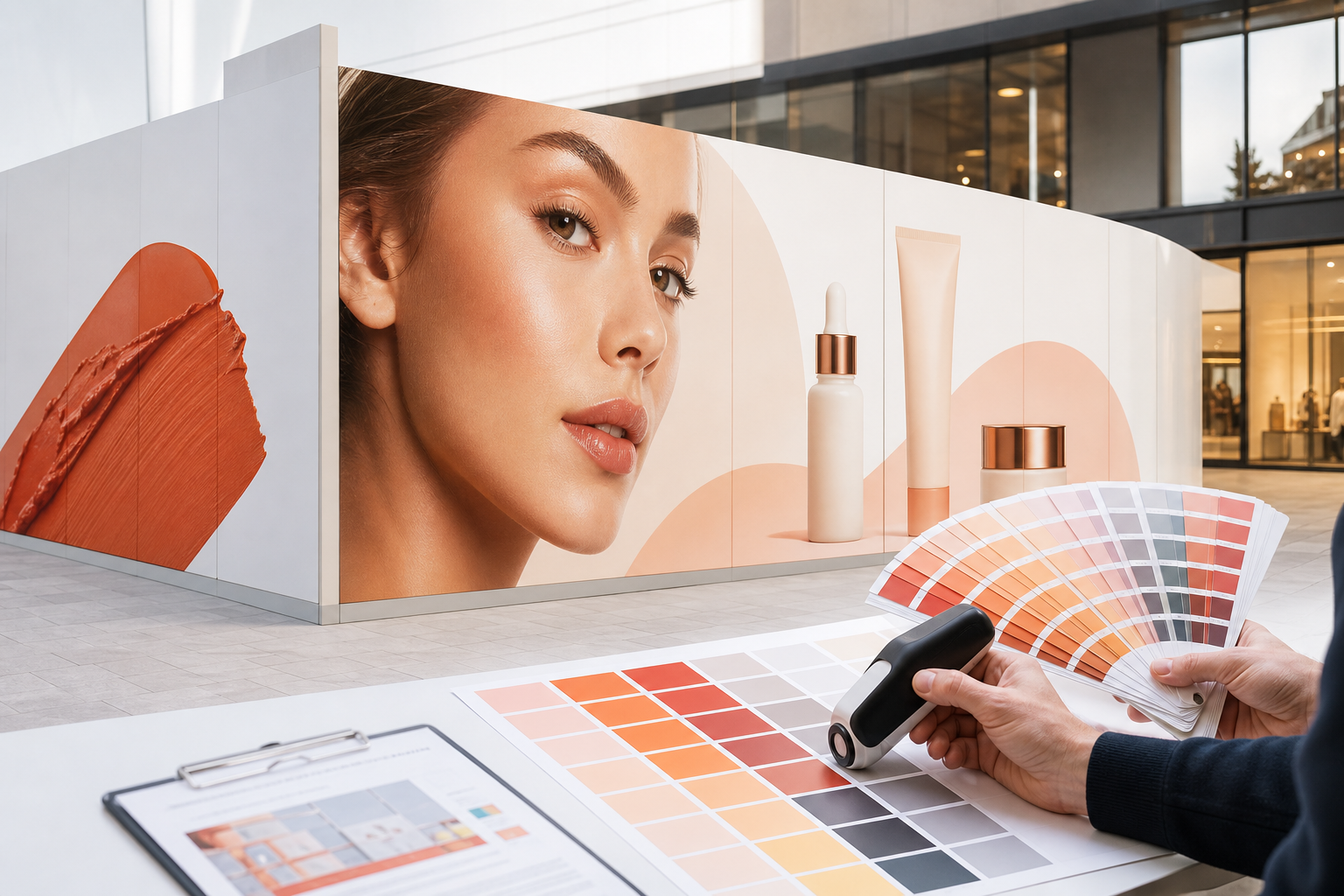
Health and beauty hoarding graphics carry a different level of scrutiny than almost any other retail category. The moment a shopper walks past a construction barrier for a Sephora, Ulta, or a prestige skincare brand, they're forming a first impression of a space that hasn't opened yet. Color accuracy, brand compliance, and turnaround times aren't secondary considerations here. They are the job.
If you're managing a health and beauty fit-out right now, you already know the pressure. A lease handover date is set. Mall operations has given you an installation window. And somewhere between your brand team's artwork files and finished panels on the wall, there are several places this project can go wrong. This article covers exactly those failure points — and what a well-run hoarding project actually looks like for health and beauty retail.
Why Health and Beauty Hoarding Is a Different Category
Not all retail hoarding carries the same brand risk. For health and beauty, the stakes are higher for a specific reason: the category runs on visual trust.
A consumer deciding whether to shop at a skincare brand or a beauty retailer is making a judgment about quality, precision, and aesthetic consistency. A hoarding panel with a slightly off-tone skin color, a gradient that banded during print, or a hero image that lost saturation in the substrate transfer sends exactly the wrong signal before the store has served a single customer.
This isn't a theoretical concern. It happens when print vendors use general-purpose substrates, when color profiles aren't managed from file to output, or when the person adapting artwork to panel layouts doesn't understand what the brand team approved at the campaign level.
Health and beauty brands also tend to carry the most complex artwork requirements in retail. Skin tones, product photography with fine specular highlights, gradient backgrounds, and precise Pantone-matched brand colors all demand a production process that treats color as a specification — not an approximation.
Color Accuracy in Large-Format Print: What Actually Matters
Large-format print for hoarding panels is not the same process as commercial offset printing. The color management requirements are different, and so are the failure modes.
Color Profiles and File Preparation
The most common source of color drift is a mismatch between the color profile embedded in the artwork file and the output profile used at the press. If your brand team submits files in Adobe RGB and the print vendor outputs in a CMYK profile calibrated for a different substrate, the result won't match the approved artwork. On a hoarding panel showing a model's face at 8 feet tall, that drift is visible from 20 feet away.
Before any health and beauty hoarding project goes to print, the artwork file should be reviewed against the output profile for the specific substrate being used. If the vendor can't tell you which color profile they're printing to, that's worth raising before production starts — not after.
Substrate Choice and Its Effect on Color
The substrate affects color output more than most clients expect. A matte laminate reads differently from a gloss finish even when the underlying print is identical. For health and beauty, where product photography is often the centerpiece of the hoarding design, the finish choice should be made with color rendering in mind, not just durability.
Cleanable finishes are standard for mall hoarding because landlords at Cadillac Fairview, Oxford Properties, and Ivanhoe Cambridge require surfaces that can be maintained during the fit-out period. The substrates that meet those durability requirements are also capable of high-fidelity color reproduction — when the print process is managed correctly.
Soft Proofing and Physical Proofing
For health and beauty campaigns, a soft proof on screen isn't sufficient approval. Screen calibration varies, and what looks correct on a brand manager's monitor in a design studio may not reflect what the substrate will actually produce. A physical proof on the actual print substrate, at a representative section of the artwork, is the only way to confirm color accuracy before committing to full production.
This adds time. Factor it into your project schedule. If your vendor doesn't offer physical proofing as part of the process, the risk of a color rejection at landlord review or brand approval falls to you.
Brand Compliance: Where Health and Beauty Projects Get Stopped
Brand compliance in hoarding graphics covers more than color. It covers the complete set of requirements that a health and beauty brand's marketing or creative team will review before approving artwork for production — and that the mall landlord will review before approving installation.
What Brand Teams Are Actually Reviewing
Brand managers at health and beauty chains are reviewing several things simultaneously: logo placement and clear space, typography weight and kerning, product image usage rights and approved crop ratios, color accuracy against brand standards, and whether the artwork adaptation from a campaign asset to a hoarding panel layout has maintained the visual hierarchy the campaign team intended.
That last point is where most problems originate. A campaign asset designed for a 16:9 digital format doesn't map directly to a series of hoarding panels at a lease line. The adaptation requires someone who understands both the technical constraints of the panel layout and the brand intent behind the original design. When that adaptation is handled by a print vendor who treats it as a scaling exercise rather than a brand exercise, the result often fails the first brand review.
What retail brand managers need to know before approving hoarding artwork covers the specific review criteria that come up most often at this stage.
Landlord Approval Requirements
Mall landlords have their own compliance requirements that sit alongside brand approval. Cadillac Fairview, Oxford Properties, and Ivanhoe Cambridge each publish hoarding standards governing panel dimensions, substrate specifications, surface finish, and in some cases the visual content itself. A hoarding design that passes brand review but fails landlord review means the project goes back to artwork — and the installation window may be lost.
The practical implication for health and beauty projects is that the artwork adaptation process needs to account for both sets of requirements from the start. If the vendor templating your hoarding panels doesn't have current knowledge of the landlord requirements at your specific mall, you'll discover the conflict at review, not before it.
The checkpoint process for brand managers approving hoarding artwork outlines how to sequence these reviews so that brand and landlord approval run in parallel rather than sequentially.
Turnaround Times: What Is Realistic and What Is Not
Health and beauty store openings are often tied to seasonal campaign launches. A brand opening in October wants hoarding up before the holiday campaign breaks. A brand opening in March is timing the fit-out to a spring campaign. The hoarding turnaround window isn't arbitrary — it's connected to a campaign calendar that was set months earlier.
The Standard Turnaround Window
From site survey to completed installation, a well-run hoarding project for a standard mall location takes 1 to 5 business days. That's not a rush service. That's the standard production and installation timeline for a project that starts with a site survey on day one and ends with installed panels on the wall by day five.
That timeline assumes artwork files are available and production-ready, or that adaptation from existing brand files can be completed within the first day or two. It also assumes mall operations has confirmed the installation window and after-hours access before the installation crew arrives.
What Delays the Timeline
Three things reliably delay health and beauty hoarding projects.
First, artwork files that aren't production-ready. A campaign asset at 72 DPI designed for digital use can't go directly to large-format print. If the vendor receives files that need to be rebuilt or upsampled, that adds time. Preparing brand files for a hoarding graphics project covers exactly what art directors need to prepare before submitting files.
Second, sequential rather than parallel review. If brand approval waits for landlord approval to complete — or vice versa — the review cycle doubles. Running both simultaneously, with a vendor who knows what each party is looking for, compresses the timeline significantly.
Third, installation coordination that isn't confirmed before the crew arrives. Mall operations at Simon, Cadillac Fairview, and other major REITs require advance notice for after-hours access. A vendor who shows up without a confirmed window gets turned away. That's a day lost, and sometimes more.
Rush Options
Rush options exist for projects where the standard 1 to 5 business day window isn't achievable. Specific rush pricing depends on project scope and is confirmed after site review. If you're working inside a compressed timeline, the instant estimate calculator gives you a budget figure without requiring a discovery call — which shortens your internal approval cycle before you've committed any time.
The Single-Vendor Argument for Health and Beauty Projects
Health and beauty brands tend to have more stakeholders in the artwork approval chain than other retail categories. The brand team, the marketing director, the regional manager, and sometimes the global brand standards team all have a view on what the hoarding looks like. That approval chain is a fixed cost of the project. What you can control is how many vendor handoffs sit underneath it.
When site survey, artwork adaptation, print production, and installation are managed by separate vendors, each handoff is a point where information gets lost or misinterpreted. The measurement from the survey needs to reach the person templating the artwork. The approved artwork file needs to reach the print vendor with the correct color profile. The printed panels need to reach the installation crew with the correct sequence and orientation. Each of those transfers is an opportunity for error.
One team managing the complete process — from survey to installed panels — removes those handoffs. For a health and beauty project where the artwork is complex and the brand approval chain is long, that matters more than it does for a simpler retail category.
The store openings timeline checklist for brand managers maps out the full sequence from lease handover to opening day, which is useful for confirming where the hoarding project sits relative to your other fit-out milestones.
Multi-Location Health and Beauty Rollouts
National health and beauty chains opening multiple locations across North American malls face an additional layer of complexity: maintaining color and brand consistency across sites that may be in different cities, under different landlords, with different panel configurations.
A single vendor managing the rollout across US and Canadian malls holds a consistent color standard across all locations because the same production process and the same color profiles apply to every site. When different regional vendors handle different locations, color consistency becomes a negotiation rather than a specification.
Project budgets for health and beauty hoarding typically range from $5,000 to $30,000 depending on the scope of the lease line and the complexity of the artwork. For multi-location programs, a per-square-foot pricing model with a single point of contact gives you predictable costs and a single accountability structure across the rollout.
FAQs
Getting health and beauty hoarding right is a production discipline, not just a print job. Color accuracy requires active management from file submission through substrate selection. Brand compliance requires a vendor who understands both the brand team's approval criteria and the landlord's technical requirements. And a 1 to 5 business day turnaround is achievable — when the project is set up correctly from the start. If you're working toward a store opening date and want a budget figure without a discovery call, the instant estimate calculator is the fastest way to get there, or get in touch with the project details.
Have a hoarding project coming up?
Get a Quote