2026-09-09
Cadillac Fairview and Oxford Properties Hoarding Standards: A Retailer's Compliance Guide
By Bryce Mitchell — Founder, Rapid Retail Graphics
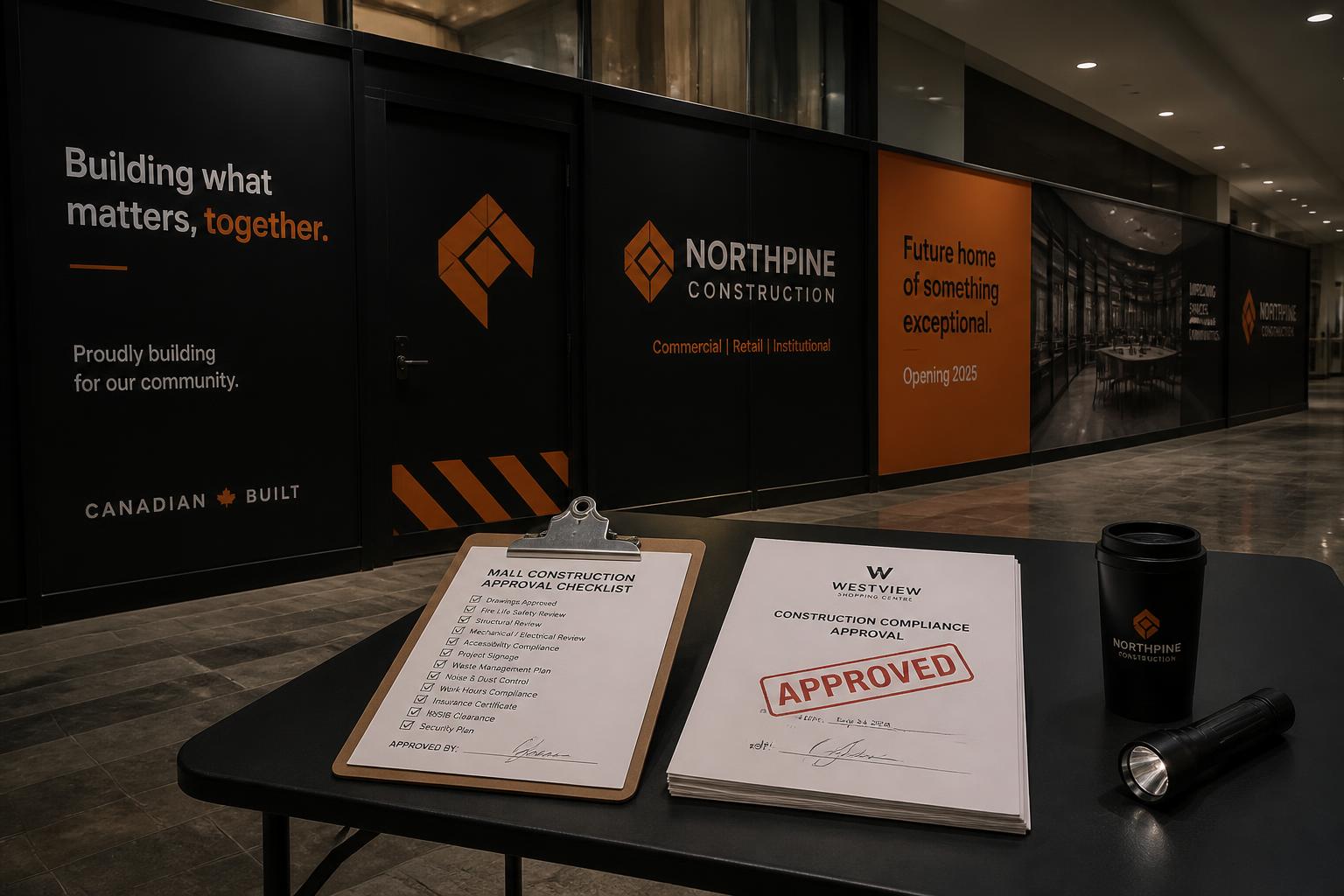
If you're managing a fit-out at a Cadillac Fairview or Oxford Properties mall, the lease is signed and the opening date is locked. What may not be mapped out yet is exactly what each landlord requires before hoarding graphics can go on the wall — and how much runway you actually need to get there.
Both REITs have requirements that go well beyond "print something and stick it up." They govern materials, finishes, artwork submission formats, installation timing, and who coordinates with mall operations. Miss a step and the install gets stopped. That falls to you to resolve, usually with a contractor standing by and a clock running.
This guide covers what each landlord typically requires, where the approval process tends to stall, and how to structure your vendor engagement so you're not chasing sign-off at the last minute. It reflects publicly available information and our own project experience at these properties — always confirm the current spec with the property directly.
Why Cadillac Fairview and Oxford Have Specific Hoarding Standards
Neither landlord is being difficult for its own sake. Both operate premium mall portfolios where the construction zone is still a consumer touchpoint. A poorly executed hoarding barrier at CF Toronto Eaton Centre or Yorkdale reflects on the property, not just the tenant.
The standards exist to protect the mall's visual environment during what is, by definition, a messy period. They also protect adjacent tenants from disruption and ensure installation crews aren't working in ways that conflict with trading hours, fire egress, or security protocols.
Understanding that logic makes the requirements easier to navigate. You're not fighting the process — you're working within a system designed to keep the mall operational while your space is under construction.
What Cadillac Fairview Typically Requires
Cadillac Fairview manages some of the highest-traffic retail destinations in Canada. Their hoarding standards reflect that scale. Calgary properties include CF Chinook Centre and CF Market Mall.
We design to the current property standards for Calgary hoarding graphics; confirm the submission requirements with each centre.
Artwork Submission and Approval
CF requires artwork approval before any printing begins. Submitting final print files before that approval is confirmed is a common and expensive mistake. The review typically evaluates brand consistency, image resolution, panel layout, and whether the design meets the property's aesthetic guidelines for that specific location.
Expect to submit files in a format specified by the property's leasing or construction team — often PDF or high-resolution TIFF with bleed and panel dimensions clearly marked. Generic brand files pulled from a campaign asset library rarely match hoarding panel dimensions without adaptation. If your vendor can't template artwork to the exact panel layout, you're adding a revision cycle you don't have time for. Our guide to file specs and panel breaks covers how to prepare files that survive review.
Material and Finish Specifications
CF properties generally require a cleanable, durable surface finish. That rules out uncoated substrates or materials that can't be wiped down by mall housekeeping. Matte laminates with anti-graffiti coatings are common. Some properties specify minimum substrate thickness to prevent panels from flexing or warping under foot traffic and HVAC airflow.
Your vendor needs to know the specific property's requirements before production starts, not after. A substrate that passes at one CF location may not meet the spec at another.
Installation Coordination
Cadillac Fairview requires installation to be coordinated with the mall's operations team. That means submitting an installation schedule in advance, confirming the crew carries the required insurance documentation, and scheduling work outside peak trading hours — typically evenings or early mornings. The step-by-step mall operations approval process sets out what gets reviewed and in what order.
The property will also want to know how panels attach to the lease line structure. Adhesive-only installs, track systems, and freestanding frames each carry different approval implications. Your vendor needs prior experience at CF properties, not be working it out on site.
What Oxford Properties Typically Requires
Oxford operates a smaller but equally premium Canadian portfolio, with flagship assets like Yorkdale Shopping Centre, Square One and Southcentre Mall in Calgary. Standards at Oxford properties tend to be rigorous, particularly at high-profile locations where the hoarding barrier sits on a major traffic corridor.
Pre-Install Documentation
Oxford typically requires a documentation package before installation is approved. This includes the artwork proof, substrate specification, installation method, and confirmation of after-hours scheduling. Some properties also require a site plan showing the hoarding footprint relative to the lease line and any adjacent tenant frontages.
If your vendor hasn't operated in an Oxford property before, this package can catch them off guard. It's not unusual for a vendor to confirm a print timeline without accounting for the two to three days needed to compile and submit the pre-install documentation.
Artwork Standards at Premium Locations
At a property like Yorkdale, the bar for artwork quality is higher than at a regional mall. Oxford's leasing and design teams pay close attention to image resolution, colour accuracy, and whether the creative execution is consistent with the brand's positioning. A pixelated hero image or a panel seam running through a face will get flagged.
This matters for how you brief your vendor. Adapting campaign creative to a hoarding layout requires someone who understands large-format output — not someone resizing a web asset and hoping it holds up at 10 feet.
Installation Timing and Mall Operations
Oxford properties use a similar after-hours model to Cadillac Fairview. Installation windows are confirmed through the property's construction or operations contact, and the crew is expected to clear the site before the mall opens. Any overrun that bleeds into trading hours creates a problem the property manager has to resolve — and that reflects on your project record with that landlord.
Where the Approval Process Stalls
The approval process at both CF and Oxford tends to stall in the same places, regardless of the property.
Artwork not templated to panel dimensions
Brand files submitted in the wrong aspect ratio or without bleed force a revision cycle. That revision cycle eats days you don't have.
Substrate not confirmed before production
If your vendor prints on a substrate that doesn't meet the property's spec, the panels can't go up. You're reprinting. The cost of the reprint is small compared to the delay.
Insurance documentation missing or expired
Mall operations won't let an uninsured crew on site. This is a straightforward requirement that gets missed more often than it should — usually because the vendor's certificate is on file somewhere but no one checked the expiry date.
Installation window not booked in advance
Both CF and Oxford book after-hours windows through their operations teams. If you haven't confirmed a window before your panels are ready, you're waiting for the next available slot. That can be days.
Artwork approval submitted too late
Submitting artwork for landlord review with less than a week before your target install date is a gamble. Both REITs can move quickly when the submission is clean, but revisions take time and the review queue doesn't stop for your timeline.
How to Structure Your Vendor Engagement for CF and Oxford Projects
The compliance process at Cadillac Fairview and Oxford Properties isn't optional, and urgency alone doesn't fast-track it. The way to get through it without losing time is to front-load the coordination.
Start with the Property's Construction Contact
Before briefing any vendor, get the specific requirements from the property's construction or leasing team. Requirements vary by location. What's accepted at CF Rideau Centre may differ from CF Pacific Centre. Get the spec sheet, confirm the submission format, and ask about current review timelines.
Choose a Vendor with CF and Oxford Experience
A vendor who has installed at Cadillac Fairview and Oxford properties before knows the documentation package, the substrate requirements, and the installation window process. That experience shortens the approval cycle because they're not asking questions that should already have answers.
If you're unfamiliar with what the full-service process looks like, the plain-language guide to hoarding in retail covers the scope from site survey through installed panels — useful context before you start comparing vendors.
Build the Timeline Backwards from the Install Window
Identify the earliest available after-hours installation window at the property. Work backwards through the approval timeline, production time, artwork templating, and site survey. In most cases, you need to be briefing your vendor at least two to three weeks before your target install date to have any margin for revisions.
For context on where the Canadian market stands in 2026 — including how landlord requirements have shifted for retail fit-outs — the 2026 Canadian mall hoarding graphics market overview covers the current environment in more detail.
Confirm the Artwork Approval Path Before Production
Know who approves artwork at the property and what the turnaround is on revisions. Some CF and Oxford properties have a 48-hour review window on clean submissions. Others take longer. Don't let your vendor start production until approval is confirmed in writing.
The Difference Between CF, Oxford, and Ivanhoé Cambridge Requirements
If you're managing fit-outs across multiple Canadian landlords, it's worth knowing where the requirements converge and where they diverge. The side-by-side view across all three landlords sets out the full comparison.
Cadillac Fairview and Oxford share a similar framework: pre-install documentation, artwork approval before print, after-hours installation, and cleanable substrate requirements. The main difference is the level of aesthetic scrutiny at specific properties. Oxford's premium locations — particularly Yorkdale — apply a higher standard to creative execution.
Ivanhoé Cambridge operates on a similar framework but has its own submission requirements, covered separately. If you're working across all three landlords, the requirements are compatible enough that a single vendor with national experience can manage all three without building separate processes for each.
For projects in Toronto specifically, the hoarding graphics guide for Toronto retail and leasing teams covers the local market context, including which properties have the most active fit-out pipelines in 2026.
What a Compliant Hoarding Program Actually Looks Like
A compliant hoarding program at a CF or Oxford property runs on a documented sequence:
- Site survey and measurements
- Artwork templating to panel dimensions
- Landlord artwork submission
- Approval confirmation in writing
- Production on the approved substrate
- Pre-install documentation package
- After-hours installation coordinated with mall operations
- Post-install sign-off
Each step depends on the one before it. A vendor who owns that sequence from survey to installed panels removes the coordination risk that causes most compliance failures. You're not chasing five separate contacts. One team manages the submission, confirms the window, and installs the panels.
Rapid Retail Graphics handles this full sequence for CF and Oxford projects — including artwork adaptation from existing brand files, substrate selection to match property requirements, and installation coordination with mall operations. The standard turnaround from site survey to installed graphics is 1 to 5 business days, with rush options available when the timeline is tight. Pricing starts at approximately $6 per square foot for print and standard installation; final pricing is confirmed after reviewing site photos and drawings.
You can get an instant estimate without a discovery call, which shortens your vendor approval cycle before you've committed any time.
FAQs
What does Cadillac Fairview require for hoarding graphics approval?
Cadillac Fairview typically requires artwork approval before printing, a cleanable and durable substrate, installation coordinated with mall operations outside trading hours, and proof of vendor insurance. Specific requirements vary by property — confirm the spec with the property's construction or leasing contact before briefing a vendor.
What does Oxford Properties require for hoarding installation?
Oxford generally requires a pre-install documentation package covering artwork proofs, substrate specifications, installation method, and confirmed after-hours scheduling. At premium locations like Yorkdale, artwork quality standards are particularly high, and pixelated or poorly adapted creative will be flagged during review.
How far in advance do I need to submit artwork for landlord approval at CF or Oxford?
A clean submission can move through review in 48 hours at some properties. Allowing at least one week before your target install date gives you room for one revision cycle. Two to three weeks of total lead time from vendor brief to installed panels is a realistic working assumption.
Can I use my brand's existing campaign files for hoarding panels at CF or Oxford properties?
Campaign files need to be templated to the exact panel dimensions of your lease line before submission. Generic brand assets are rarely the right aspect ratio or resolution for large-format hoarding output. A vendor with hoarding experience will adapt your files to the panel layout rather than simply scaling them.
What happens if my hoarding install doesn't meet CF or Oxford standards?
The install gets stopped. You'll need to reprint on the correct substrate, resubmit artwork, or reschedule the installation window — all of it against a fixed opening date. The compliance failures that cause this outcome are almost always preventable with the right vendor and enough lead time.
Do Cadillac Fairview and Oxford Properties have the same hoarding requirements?
The frameworks are similar: artwork approval, cleanable substrates, after-hours installation, and pre-install documentation. The differences are in the level of creative scrutiny at specific properties and the exact documentation format each requires. A vendor with experience at both REITs will know the distinctions.
How do I find out the specific hoarding requirements for a particular CF or Oxford property?
Contact the property's construction or leasing team directly. They'll provide the current spec sheet, submission format, and review timeline. Requirements can differ between properties within the same portfolio, so always confirm at the property level rather than assuming the requirements are uniform across the REIT.
The compliance process at Cadillac Fairview and Oxford Properties is manageable when you know what's required and build your timeline around it. The projects that go wrong aren't the ones with hard opening dates. They're the ones where the vendor didn't know the property's requirements, or where artwork approval was treated as a formality rather than a gate.
Get the spec before you brief a vendor. Choose someone who has done this before at these properties. Build enough runway that a single revision cycle doesn't put your opening date at risk.
Have a hoarding project coming up?
Get a Quote