2026-05-04
Mall Hoarding Graphics: What Cadillac Fairview, Oxford, and Ivanhoé Cambridge Actually Require
By David Chen — Senior Project Coordinator, 12+ Years in Retail Hoarding Across Canadian Shopping Centres
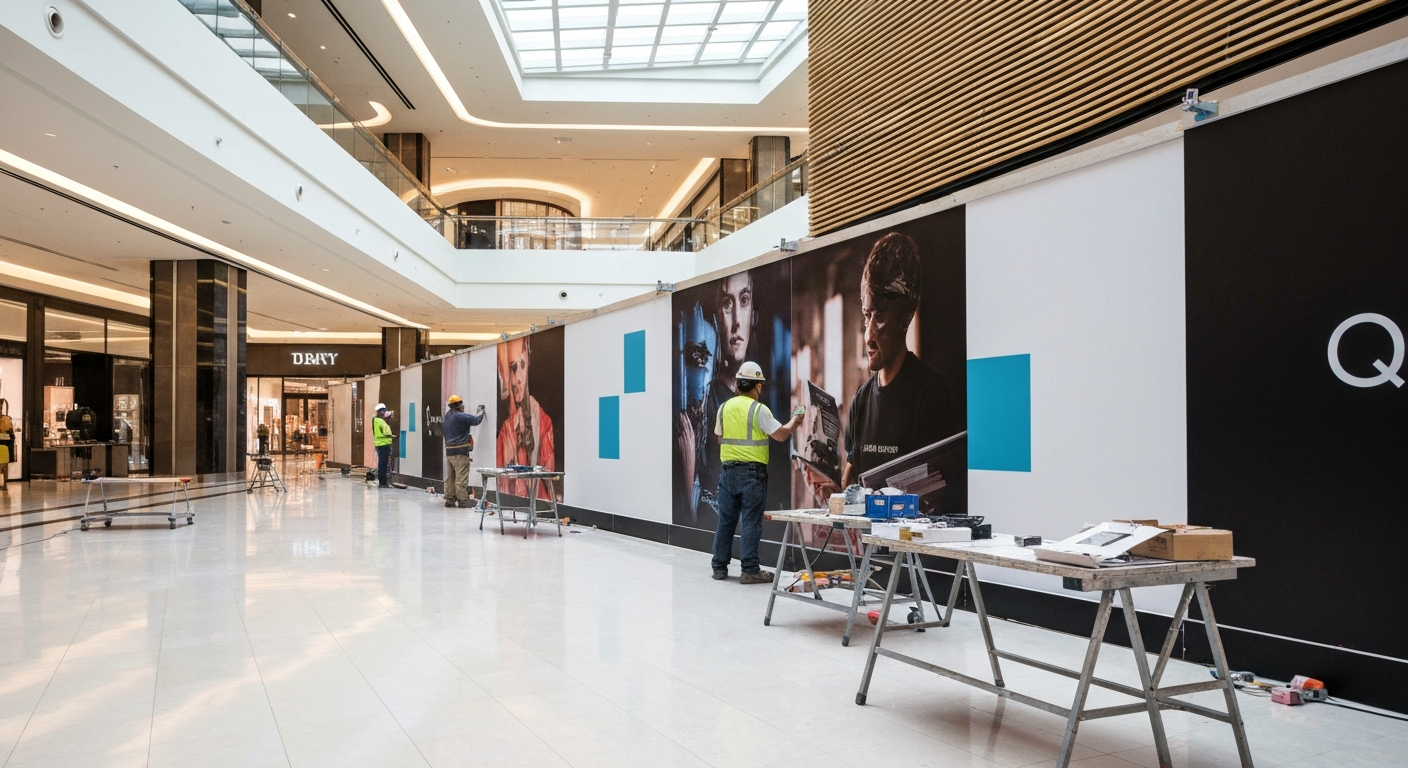
The lease is signed, the fit-out contractor is scheduled, and your brand team has sent over creative. The hoarding goes up in two weeks. Then the landlord's marketing team comes back with a revision list, and the timeline starts to slip.
This is one of the most common friction points in retail fit-outs across Canada. The creative usually isn't the problem. The problem is that the artwork was built without accounting for what Cadillac Fairview, Oxford, or Ivanhoé Cambridge actually need before they'll sign off.
Each of these landlords runs its own submission process, its own preferred specifications, and its own review timelines. Knowing those requirements before you go to print is not a nice-to-have — it's the difference between an on-time opening and a bare hoarding wall on launch day.
Why Landlord Requirements Matter More Than You Think
Construction hoarding in a mall isn't just a print job. It occupies common area managed by the landlord, visible to thousands of shoppers every day. That makes it subject to the landlord's brand standards, centre aesthetics, and in some cases, municipal signage bylaws.
Major Canadian landlords treat hoarding graphics as a formal submission — not a courtesy notification. You submit artwork, they review it, and they either approve it or send it back. Every revision cycle costs time.
At a property like Cadillac Fairview's Rideau Centre or Oxford's Yorkdale Shopping Centre, a clean submission can clear review in 5 to 10 business days. Add a revision cycle and that window grows. A vendor unfamiliar with these requirements will either delay the job or trigger a compliance issue that forces a redo.
For a closer look at how this process works from the leasing side, this guide for leasing coordinators covers the full submission and approval workflow.
What Cadillac Fairview Typically Requires
Cadillac Fairview manages some of the highest-traffic retail properties in Canada — CF Toronto Eaton Centre, CF Pacific Centre, CF Masonville Place, CF Chinook Centre and CF Market Mall in Calgary. Their hoarding graphic standards reflect that. They're detailed, and they're enforced.
Artwork Specifications
CF properties generally require print-ready files at a resolution that produces clean output at full scale, with bleed extending past the panel edges. Artwork must account for the physical structure of the hoarding system — seams, doors, and any recessed sections need to be mapped in the artwork template before production begins.
Brand-accurate colour reproduction is expected. If your creative uses specific Pantone references, flag them during submission so the reviewing team can assess whether the printed output will match.
Content and Messaging Standards
CF's marketing teams review hoarding creative for alignment with the centre's overall aesthetic. Overtly promotional content — heavy discounting language, countdown timers, anything that reads more like a flyer than a brand statement — tends to draw revision requests.
Coming soon messaging is generally acceptable, but the format and placement are sometimes specified by the centre. Check the tenant coordination package for your specific property.
Access and Installation Coordination
Installations at CF properties require formal contractor access requests submitted at least 48 to 72 hours in advance. Work is typically scheduled outside of trading hours, which at a property like CF Toronto Eaton Centre may mean a narrow overnight window. Your installer needs to know the centre's loading dock and elevator protocols before arriving on-site.
What Oxford Properties Typically Requires
Oxford manages Yorkdale Shopping Centre in Toronto, Scarborough Town Centre, Southcentre Mall in Calgary, and a number of other major retail assets across Canada. Their hoarding review process sits within the tenant coordination team, and Yorkdale's standards in particular are among the most rigorous in the country.
Panel System and Template Requirements
Oxford properties often use specific hoarding panel systems — typically plywood panel systems with defined dimensions. Artwork must be templated to those exact panel sizes, with seams and hardware positions accounted for. Submitting artwork without a prior site survey is a common mistake. If your files don't match the actual panel layout, they go back.
A proper on-site measurement visit before any artwork is produced eliminates this entirely.
Brand and Visual Standards
Yorkdale positions itself as a luxury and premium retail destination, and the hoarding graphic standards reflect that. Low-resolution imagery, busy layouts, or creative adapted from a smaller-format campaign without adjustment tends to get flagged.
The expectation is that the hoarding looks like it belongs in the centre — not like it was produced quickly and dropped in.
Approval Timelines
Oxford's tenant coordination teams are responsive, but they operate on structured review cycles. Submitting artwork on a Friday afternoon for a Monday install isn't a realistic plan. Build at least 5 business days of review time into your project schedule, and assume one revision cycle is possible even with a strong submission.
What Ivanhoé Cambridge Typically Requires
Ivanhoé Cambridge operates Metropolis at Metrotown in Burnaby, Quartier DIX30 in Brossard, CrossIron Mills in the Calgary area, and several other major centres across Canada. Their hoarding standards vary somewhat by property, but certain requirements are consistent across the portfolio.
We design Calgary hoarding graphics to these standards, with the current submission package confirmed by each property's tenant-coordination team.
Structural and Substrate Requirements
Ivanhoé Cambridge properties typically specify the substrate that hoarding graphics must be printed on or applied to. Adhesive vinyl applied directly to a painted hoarding surface is common, but some properties require rigid panel systems or specific finishes — matte laminate is frequently required to reduce glare in high-ambient-light areas.
If your vendor doesn't ask about substrate requirements before quoting, that's a gap. The wrong substrate can trigger a rejection at inspection, and replacing installed graphics after the fact is expensive.
Bilingual Signage Requirements
At Quebec properties like Quartier DIX30, bilingual content requirements apply. Any text on the hoarding — coming soon messaging, brand taglines, promotional copy — needs to meet provincial language requirements. This affects both the artwork and the approval submission. If your brand's standard creative is English-only, build in time for translation review.
Fire and Safety Compliance
Like most major landlords, Ivanhoé Cambridge requires that all materials used in hoarding graphics meet fire-rating standards for interior commercial applications. Your vendor needs to provide documentation confirming that the substrates and adhesives used are compliant. This isn't something to sort out after the job is printed.
Where Most Retail Marketing Graphics Submissions Go Wrong
Across all three landlords, the same categories of issues come up repeatedly.
No site survey before artwork production. Artwork built from approximate measurements or old drawings rarely fits the actual panel layout. The result is a reprint.
Artwork submitted without a template. Each hoarding has a specific panel configuration. Submitting a flat image without mapping it to that structure means the landlord's team has to do that work — and they'll send it back instead.
Incorrect or missing bleed. Print-ready files need to extend past the edge of each panel. Files submitted without proper bleed get returned.
Promotional content that doesn't match the centre's standards. Discount messaging, aggressive sale language, or creative that looks out of place in the centre's environment draws revision requests. Review the centre's tenant design criteria before finalizing creative direction.
Underestimating the review timeline. Submitting artwork five days before the planned install date, with no buffer for revisions, fails more often than it works.
The 5 mistakes retailers make with hoarding graphics covers these in more detail if you want a fuller breakdown before your next submission.
How to Get Artwork Approved Faster
The fastest approvals come from submissions that require no follow-up. That means:
- Complete the site survey first. Measurements and photos of the actual hoarding structure before any artwork is produced.
- Request the landlord's artwork template. Most tenant coordination teams have one. Use it.
- Submit a complete package. Artwork files, a panel layout diagram, material specifications, and contractor access details in one submission. Incomplete packages create back-and-forth.
- Flag anything non-standard upfront. If your creative includes an unusual finish, a die-cut element, or a material the landlord hasn't seen before, note it in the submission and explain why it meets their standards.
- Build in a revision cycle. Even strong submissions sometimes come back with minor notes. Assume it and schedule accordingly.
For projects spanning multiple locations — opening in both a CF and an Oxford property in the same quarter, for example — the coordination requirements compound. This guide on multi-location hoarding graphics covers how to manage parallel approval tracks without losing control of the timeline.
Working With a Vendor Who Knows the Process
The requirements above aren't secret. They're documented in tenant coordination packages and design criteria guides. The problem is that most general print vendors don't work with these landlords regularly enough to know where the friction points are.
A vendor who hasn't installed at Yorkdale before won't know that the loading dock access protocol differs from most other Oxford properties. A vendor who hasn't worked with Ivanhoé Cambridge properties in Quebec won't flag the bilingual requirement until the artwork is already in review.
Rapid Retail Graphics works directly with mall operations and security teams to coordinate installs — often outside trading hours — and handles the contractor access process as part of the project. Site survey, artwork templating, print production, and installation are managed as a single workflow, not handed off between separate vendors.
For more on how installation coordination works with mall operations specifically, this article on coordinating hoarding installs with mall security and operations is worth reading before your next project.
FAQs
Plan the Submission Before You Brief the Creative Team
The landlord requirements at CF, Oxford, and Ivanhoé Cambridge properties are specific, documented, and consistently applied. The brands and leasing teams that move fastest treat those requirements as part of the project brief — not as an obstacle to work around after the artwork is already done.
If you're planning a fit-out at one of these properties and want to understand the submission requirements before you start, get an instant estimate or request a detailed quote — or call (604) 220-7700 to talk through the specifics before you commit to a date.
Have a hoarding project coming up?
Get a Quote