2026-05-04
Hoarding Graphics in Toronto: What Retail and Leasing Teams Need to Know in 2026
By Mike Torres — Senior Install Coordinator, 12+ Years in Retail Fit-Out
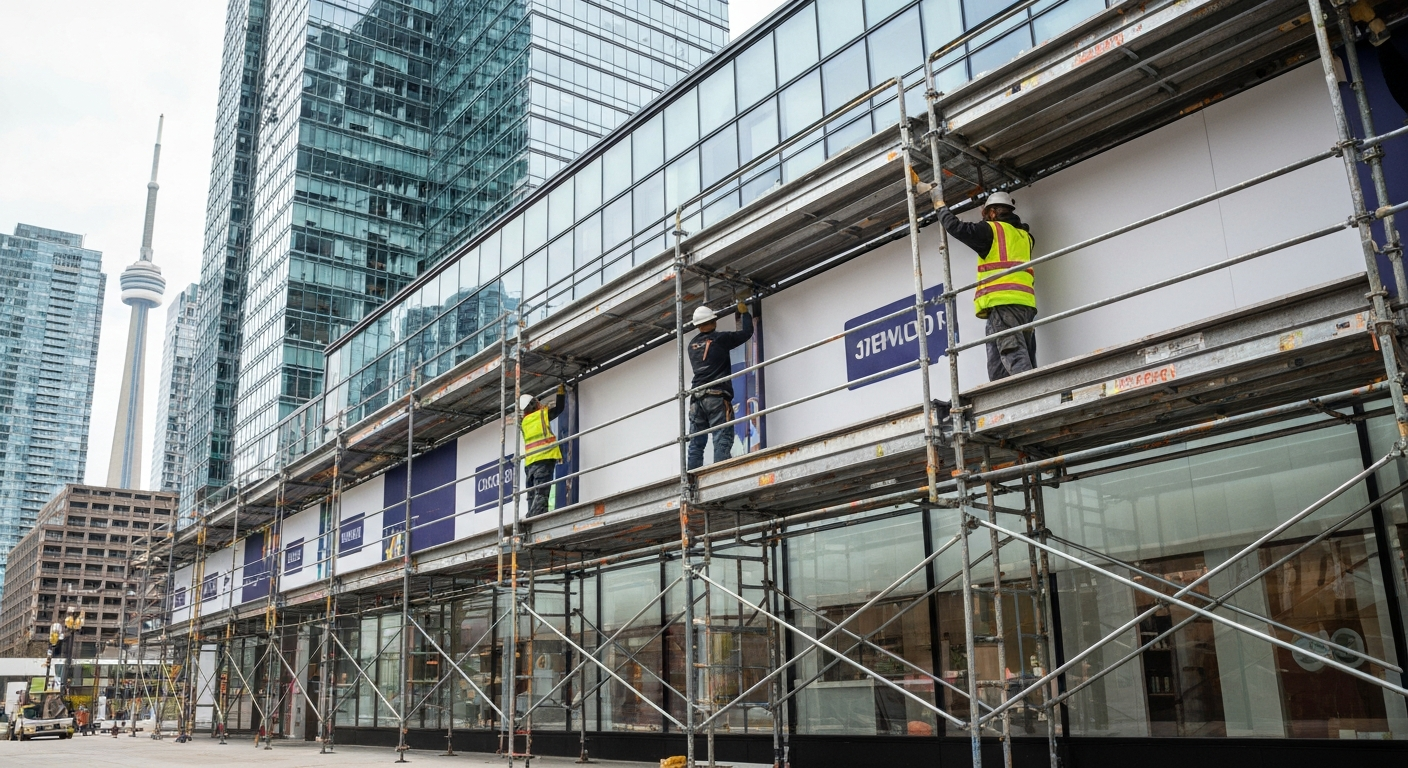
You already know what retail hoarding is. You've approved it, chased it, and probably had at least one tense conversation with a contractor about it. The question isn't what it is — it's how to get it done correctly in Toronto, where the mall portfolio is dense, landlord requirements vary by property, and a missed installation window means your barrier goes up bare.
This article covers the specifics: which landlords you're working with, what they require, what goes wrong most often, and what a realistic timeline looks like in 2026.
What Makes Toronto Different for Retail Hoarding
Toronto has one of the highest concentrations of enclosed mall retail in Canada. Across the GTA, you're dealing with properties managed by Cadillac Fairview, Oxford Properties, Ivanhoé Cambridge, and SmartCentres, among others. Each has its own vendor approval process, its own hoarding specification sheet, and its own access protocols.
That density creates pressure. More retail activity means more fit-outs running simultaneously, which means mall operations teams are juggling multiple contractor requests at once. Your access window isn't guaranteed just because you submitted a request.
If you're managing a brand with stores at Yorkdale, Scarborough Town Centre, and CF Toronto Eaton Centre opening in the same quarter, the coordination load multiplies fast.
The Landlords You're Likely Dealing With
Cadillac Fairview
CF manages several of Toronto's highest-traffic properties, including CF Toronto Eaton Centre and CF Sherway Gardens. Their hoarding specifications typically require pre-approved artwork, specific substrate requirements, and contractor credentials submitted at least 48 to 72 hours before any on-site work begins. Artwork that hasn't cleared their marketing team before going to print is wasted production.
Oxford Properties
Oxford's Toronto portfolio includes Yorkdale Shopping Centre — one of the most active fit-out environments in the country. Yorkdale's foot traffic and visibility standards mean hoarding graphics get scrutinized more closely than at lower-profile properties. Expect detailed spec sheets and a review cycle that can add 2 to 3 business days to your timeline if you're not prepared.
Ivanhoé Cambridge
Ivanhoé Cambridge properties, including Scarborough Town Centre, follow a similar approval structure. Their operations teams coordinate contractor access carefully, and installations outside trading hours are often the only option for larger hoarding walls. The property-by-property landlord requirements guide breaks down what each major Canadian landlord expects.
SmartCentres and Smaller Landlords
Power centre and strip mall properties tend to have lighter approval requirements — but don't read that as no requirements. Even smaller landlords have insurance, liability, and finish standards that a vendor unfamiliar with the property will miss.
Common Compliance Mistakes in Toronto Malls
Most hoarding problems in Toronto aren't caused by bad creative. They're caused by process failures that happen before anything goes to print.
Artwork submitted without landlord review. Every major Toronto mall landlord requires artwork approval before production. Submitting print-ready files without that sign-off means you're printing at risk. If the landlord requests changes, you reprint — and that costs both money and time.
Wrong panel dimensions. Hoarding walls in older Toronto properties — particularly CF Eaton Centre and Scarborough Town Centre — often have irregular panel configurations due to structural constraints. If your vendor measures from drawings rather than conducting an on-site survey, you'll find out the panels don't fit on installation day. The site survey guide covers exactly what gets measured.
Substrate that doesn't meet finish requirements. Some Toronto properties specify matte laminate finishes to reduce glare in high-traffic corridors. Gloss prints on those walls will fail inspection. A vendor who doesn't know the property's spec sheet will produce the wrong finish.
Contractor credentials not submitted in advance. Mall operations teams require contractor documentation — insurance certificates, worker credentials, equipment lists — before access is granted. Missing this by even one day pushes your install to the next available window.
Timelines That Actually Work in This Market
A realistic end-to-end timeline for a Toronto mall hoarding project in 2026 looks like this:
- Day 1: Brief submitted, site survey scheduled
- Day 2: On-site survey completed, measurements and site photos collected
- Days 3–4: Artwork adapted to hoarding layout, first proof sent for review
- Day 5: Landlord artwork approval obtained (if pre-submitted correctly)
- Days 6–8: Print production
- Days 9–10: Installation coordinated with mall operations, completed outside trading hours
That's a 9 to 10 business day cycle from brief to installed graphics — assuming no revision loops and no delays in landlord approval. Rush options can compress production and installation, but the landlord approval step has a minimum cycle time you can't shortcut.
If your lease commencement date is two weeks out and you haven't started this process, you're already behind.
Materials and Finishes That Pass Inspection
Toronto mall landlords are specific about what goes on their walls. The most commonly approved options include:
- Matte laminate vinyl applied to plywood panel systems — the standard across most CF and Oxford properties.
- Fabric tension systems in higher-end or heritage properties where adhesive application isn't permitted.
- Rigid substrate panels (PVC or aluminum composite) for permanent-feel installations in flagship locations.
The substrate choice affects print lead time, installation method, and cost. It also affects durability. A hoarding that goes up in November at a high-traffic Toronto mall needs to hold through the holiday shopping season. Finishes that aren't rated for cleanability or high contact will show wear within weeks.
If you're unsure what a specific property requires, the landlord's tenant coordination team will have a current spec sheet. Ask for it before you brief your vendor.
Who Coordinates What — and When
Unclear ownership of coordination steps is one of the most common sources of delay on Toronto hoarding projects. Here's how responsibilities typically break down:
The leasing coordinator or tenant rep owns the landlord relationship, the artwork approval submission, and the contractor access request. These aren't tasks to hand off to the print vendor without confirming they've handled them before.
The retail brand manager owns the creative brief and brand approval. If there's a campaign running, the hoarding creative needs to align with it — which means the brand team needs to be in the loop before artwork is adapted, not after.
The hoarding graphics vendor owns site survey, artwork adaptation, print production, and installation coordination with mall operations. A full-service vendor handles all of this. A print-only vendor hands off after production, which means you're coordinating the install yourself. The full-service vs. print-only comparison lays out exactly where the differences show up on a project.
Multi-Location Projects in the GTA
Rolling out hoarding graphics across multiple Toronto-area locations at once — say, three stores across Yorkdale, Fairview Mall, and Square One in Mississauga — adds significant coordination complexity.
Each property has its own approval cycle, its own access schedule, and its own on-site conditions. A vendor managing all three needs to run parallel workflows, not sequential ones. Sequential processing adds 5 to 8 business days to a multi-location rollout that a parallel approach would complete in the same time as a single install.
For more on managing multi-location projects efficiently, see the multi-location hoarding graphics guide for Canadian retail chains.
When to Refresh Existing Hoarding Graphics
Toronto's retail environment moves fast. A hoarding that went up in January with a "coming soon" message is a missed opportunity by April if the creative hasn't been updated to reflect the actual opening timeline or a seasonal campaign.
Stale hoarding graphics aren't just an aesthetic issue. They signal to shoppers — and to the landlord's marketing team — that the brand isn't actively managing its presence. At a property like Yorkdale, where foot traffic is high and the tenant mix is competitive, that impression has real consequences.
A refresh doesn't always require a full reprint. If the panel system is intact and the substrate is in good condition, updated graphics can be applied over or in place of existing panels. The key is assessing the on-site condition before committing to a production approach.
For a full breakdown of when and how to schedule a hoarding refresh, see the seasonal retail refresh guide.
FAQs
Getting Started
Toronto's mall market doesn't leave much room for process errors. Landlord approval cycles, access windows, and installation logistics all have fixed minimum timelines — and they don't flex because a lease commencement date shifted.
If you're managing a fit-out, relocation, or renovation at a Toronto-area property, the place to start is a site survey and a clear brief. For more on how the full process works, see the leasing coordinator guide to hoarding graphics in Canadian shopping centres and the guide on coordinating hoarding graphics installs with mall security and operations.
To scope a Toronto project, run an instant estimate or request a detailed quote — or call (604) 220-7700.
Have a hoarding project coming up?
Get a Quote