2026-09-09
Luxury Retail Hoarding Graphics: Premium Materials, Tight Brand Standards, and Approval Workflows
By Bryce Mitchell — Founder, Rapid Retail Graphics
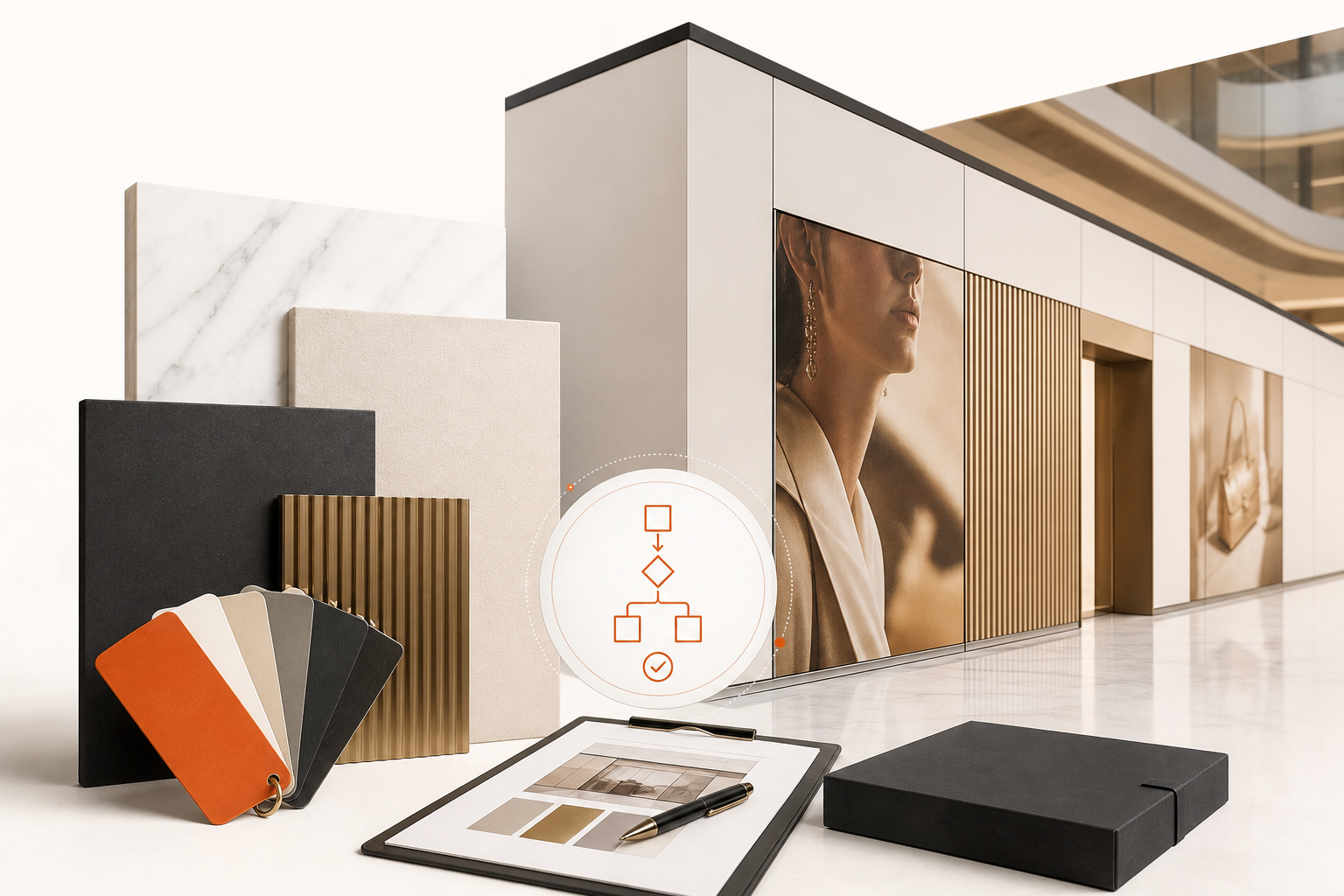
Luxury retail hoarding operates under a different set of rules than standard construction barriers. The materials are more demanding, the brand standards are stricter, and the approval workflows involve more stakeholders — often regional brand managers, global creative directors, and mall landlord design teams reviewing at the same time.
If you're managing a luxury retail fitout at a Cadillac Fairview, Oxford, or Ivanhoé Cambridge property, you already know a generic print vendor with a wide-format printer and a two-day turnaround won't get you there. The question isn't whether to take hoarding graphics seriously. It's whether your vendor understands what "seriously" means at this level.
This article covers what separates a competent luxury hoarding execution from a failed one: substrate selection, print quality thresholds, the brand approval process, and the landlord review layer that runs on top of it.
Why Luxury Hoarding Is a Different Category
Standard retail hoarding needs to be legible, on-brand, and installed before opening. That's the bar.
Luxury hoarding raises it significantly. The construction barrier isn't just a temporary partition — it's a brand touchpoint in a premium environment. A flagship opening at Yorkdale, Rideau Centre, or CF Pacific Centre puts the hoarding directly in front of the brand's target customer. The barrier has to perform like a window display, not a job-site fence wrap.
That means substrate, print quality, and finish all have to hold up under close inspection. Shoppers at luxury malls walk past hoarding at arm's length. They notice texture. They notice banding in gradients. They notice a seam that doesn't align.
A poorly executed hoarding installation at a flagship opening signals something about the brand before the doors open.
Substrate Selection for Luxury Hoarding Panels
The substrate decision is where most general print vendors fall short. For luxury retail, the choice of material affects print quality, surface finish, and how panels read under mall lighting. Our guide to materials and finishes for high-traffic malls covers how each option behaves in service.
Rigid Panels vs. Vinyl Wraps
Vinyl wraps applied to existing hoarding frames are common in standard retail. They're fast to produce and relatively inexpensive. For luxury applications, they introduce problems that are difficult to manage at scale.
Vinyl wraps can develop bubbles, lifting edges, and surface inconsistencies — particularly in mall environments with variable humidity and foot traffic vibration. Under the direct lighting typical of luxury mall corridors, those imperfections become visible at conversational distance.
Rigid panels — typically aluminum composite or PVC foam board — give you a flat, stable print surface that holds up under close inspection. The print sits on a substrate that doesn't flex or shift, which matters for large-format photography and fine typographic detail.
Print Surface and Finish
Luxury brand standards frequently specify matte or satin finishes to avoid glare under overhead lighting. Gloss finishes, which are standard for most wide-format print, create hotspots under mall lighting that wash out imagery and make text harder to read.
If your brand guidelines specify a particular finish, confirm your vendor can match it on the substrate you're using. Not all substrates accept the same laminate options, and a vendor who hasn't done luxury hoarding before may not flag this conflict until after production.
Seam Placement and Panel Alignment
Luxury hoarding runs often involve large-format photography — full-bleed portraits, architectural imagery, brand campaign visuals spanning multiple panels. Seam placement on these layouts requires planning at the artwork stage, not the installation stage. Our guide to file specs and panel breaks sets out how to plan those breaks before production.
A seam running through a face, a logo, or a key product image is a production failure. It means the artwork wasn't templated to the actual panel layout. For luxury retail, this isn't recoverable — you don't patch it and move on. You reprint.
Brand Standards and Artwork Adaptation
Luxury brands maintain detailed guidelines governing typography, color, imagery usage, and spatial relationships. Applying those guidelines to a hoarding layout is not the same as applying them to a print ad or a window display.
What Artwork Adaptation Actually Involves
Most luxury brands will provide campaign files — high-resolution photography, approved typefaces, color-matched assets. What they won't provide is a file sized and templated to the specific hoarding configuration at a specific mall location.
That templating work requires accurate site measurements, an understanding of the panel layout, and the ability to recompose campaign imagery within the constraints of the hoarding footprint without violating brand rules. It's not a design project. It's a technical adaptation that requires both print production knowledge and brand sensitivity.
A vendor who treats this as a simple resize produces artwork that technically uses the right assets but reads wrong — cropped awkwardly, with spatial relationships that don't match the original campaign intent.
Color Accuracy Under Mall Lighting
Mall lighting varies significantly by property and corridor. Luxury hoarding in a Nordstrom-anchored wing of a CF mall may sit under warm LED downlighting that shifts perceived color temperature. What looks correct on a monitor or a press proof can read differently on the wall.
Color-critical luxury brands — particularly those with proprietary brand colors — need vendors who understand this and adjust production accordingly. This isn't about getting close. It's about matching the approved color under the actual installation conditions.
If your brand has a specific Pantone reference that needs to translate accurately to wide-format print, confirm your vendor has a calibration process for the specific substrate and finish you're using. Vague assurances about "color accuracy" aren't enough.
Typography and Spacing
Luxury brand guidelines are often precise about minimum type sizes, kerning, and clear space around logos. These rules protect legibility and brand equity. They also create constraints a vendor unfamiliar with the brand may not respect.
Artwork adaptation for luxury hoarding needs to happen with the brand guidelines open, not from memory. If you're working with a vendor who hasn't seen your guidelines before, build a review checkpoint into the workflow before production begins.
Reviewing what brand managers need to verify before approving hoarding artwork is worth doing before you brief any vendor on a luxury project.
The Approval Workflow: Two Layers Running Simultaneously
Luxury hoarding projects typically involve two parallel approval tracks: internal brand approval and landlord review. Both have to clear before production can begin. Managing them sequentially adds days you usually don't have.
Internal Brand Approval
For luxury brands, internal approval often involves more stakeholders than a standard retail project. Regional marketing, the global brand team, and legal — for campaign imagery rights in a specific context — may all need to sign off.
The practical implication: your artwork needs to be production-ready before it enters the internal review cycle. Submitting rough layouts to a global brand director wastes everyone's time and extends the cycle. Submit finished artwork with accurate dimensions, correct color references, and all brand elements placed correctly.
The checkpoint process for brand managers approving hoarding artwork outlines the specific review stages that prevent last-minute revision cycles.
Landlord Review
Cadillac Fairview, Oxford, and Ivanhoé Cambridge each maintain design standards for hoarding installations at their properties. These standards govern panel height, finish specifications, acceptable imagery content, and in some cases the typefaces and color palettes permitted within the mall's design language. The CF and Oxford compliance guide and the Ivanhoé Cambridge submission checklist cover what each typically asks for.
Landlord review runs on the landlord's timeline, not yours. Submitting artwork that hasn't been checked against the property's hoarding standards risks a revision request that delays your entire production schedule.
The approval differences between retail signage and hoarding graphics affect what you submit and to whom — worth understanding before anything goes in for review.
Running Both Tracks in Parallel
Vendors who handle luxury hoarding well understand that internal brand approval and landlord review need to run at the same time. That requires submitting artwork to both tracks simultaneously, which requires artwork that's ready for both audiences at once.
This is harder than it sounds. Brand teams care about creative fidelity. Landlord design teams care about compliance with property standards. A single set of artwork has to satisfy both, and any revision requested by one party may require re-review by the other.
Build this into your timeline. Two to four weeks out from a handover date, artwork should already be in review — not still in production.
Installation Standards for Luxury Environments
Even perfect artwork fails if the installation is poor. For luxury hoarding, installation quality is part of the brand expression.
After-Hours Installation
Luxury mall properties typically require after-hours installation for construction hoarding to avoid disrupting the shopping environment. This isn't optional — it's a condition of the landlord's approval. A vendor who can't coordinate after-hours installation can't complete the job.
After-hours installation also reduces the risk of damage during the process. Panels moved through a busy mall corridor during trading hours face a different set of risks than panels installed in an empty corridor at 11pm.
Panel Alignment and Finishing
The finishing details matter. Panel edges need to be clean. Seams need to be tight. Any trim or capping specified in the landlord's hoarding standards needs to be installed correctly.
A vendor who treats installation as a subcontracted task — handed off to a crew that hasn't seen the artwork or the landlord's specifications — introduces coordination risk at the last stage of the project. That risk falls to you when something goes wrong at 2am before an opening.
Site Survey Before Artwork Production
Accurate site measurements are non-negotiable for luxury hoarding. Mall hoarding configurations are rarely perfectly square. Columns, doorways, and service access points create irregular panel layouts that have to be accounted for in the artwork.
A site survey before artwork production prevents the most common luxury hoarding failure: artwork templated to nominal dimensions that doesn't match the actual installation. On a standard retail project, you might adjust on-site. On a luxury project with full-bleed photography and precise brand standards, there's no adjusting on-site. You reprint.
What to Ask a Vendor Before Committing
These are the questions that separate capable vendors from ones who will create problems:
- What substrates do you recommend for luxury retail hoarding, and why?
- How do you handle seam placement on full-bleed photography layouts?
- What's your process for color calibration on matte or satin finishes?
- Have you worked with this landlord before, and are you familiar with their hoarding standards?
- How do you coordinate after-hours installation, and who manages that directly?
- What's your turnaround from artwork approval to installed panels?
- Do you conduct site surveys before artwork production, or do you work from provided measurements?
A vendor who answers all seven specifically and without hesitation has done this before. A vendor who hedges on any of them is telling you something important.
Rapid Retail Graphics handles the complete process — site survey, artwork adaptation, production, and after-hours installation — for luxury retail brands and mall landlords across North America. You can review the full scope of the service, pricing and turnaround, or send us your project details.
FAQs
What makes luxury retail hoarding graphics different from standard hoarding?
Luxury hoarding operates under tighter brand standards, requires higher print quality on premium substrates, and involves more complex approval workflows — including both internal brand review and landlord design team sign-off. The barrier is a brand touchpoint in a premium environment, not just a construction partition.
What substrates work best for luxury hoarding panels?
Rigid substrates — aluminum composite or PVC foam board — are generally preferred for luxury applications. They provide a stable, flat print surface that holds up under close inspection and doesn't develop the surface imperfections that vinyl wraps can show. The specific choice depends on the panel configuration and the finish specified in the brand guidelines.
How long does landlord approval take for luxury hoarding at major mall properties?
It varies by property and REIT. Cadillac Fairview, Oxford, and Ivanhoé Cambridge each run their own review processes on their own timelines. Building two to four weeks into your schedule for artwork review — running brand approval and landlord review simultaneously — is the standard approach for avoiding production delays.
Can luxury brand campaign files be adapted to a hoarding layout without violating brand guidelines?
Yes, but it requires technical artwork adaptation, not just resizing. The process involves templating campaign assets to the specific panel configuration, placing seams away from critical imagery, and maintaining all spatial and typographic relationships specified in the brand guidelines. This is distinct from general design work and requires both print production knowledge and familiarity with the brand's standards.
Why does seam placement matter so much for luxury hoarding?
Luxury hoarding frequently uses full-bleed photography spanning multiple panels. A seam through a face, a logo, or a key product image is a production failure that requires reprinting. Seam placement has to be planned at the artwork stage, using accurate site measurements, before production begins.
What happens if brand approval and landlord approval conflict?
It happens. A brand team may approve artwork that doesn't meet the landlord's hoarding standards, or a landlord may request changes that conflict with brand guidelines. The resolution usually involves a revision cycle that both parties need to clear. Running both tracks simultaneously from the start gives you more time to resolve conflicts before they affect your installation date.
How do I know if a vendor can handle luxury hoarding specifically?
Ask them directly about substrate options, seam planning process, color calibration approach, and experience with the specific landlord whose property you're working in. A vendor with genuine luxury hoarding experience will answer these questions specifically. Vague references to "quality" and "experience" are a signal to keep looking.
The Standard Is Set Before the Doors Open
Luxury retail hoarding is not a background element. It's the first thing your customer sees. Getting it right means choosing the right substrate, adapting artwork with precision, running approval workflows in parallel, and installing after hours with a crew that knows what they're doing.
Every one of those steps is a point where a general vendor can fail you. The vendors who handle luxury hoarding well treat it as a distinct discipline — because it is.
Have a hoarding project coming up?
Get a Quote