2026-10-13
Amgraph Group vs Full-Service Hoarding Vendors in 2026
By Bryce Mitchell — Founder, Rapid Retail Graphics
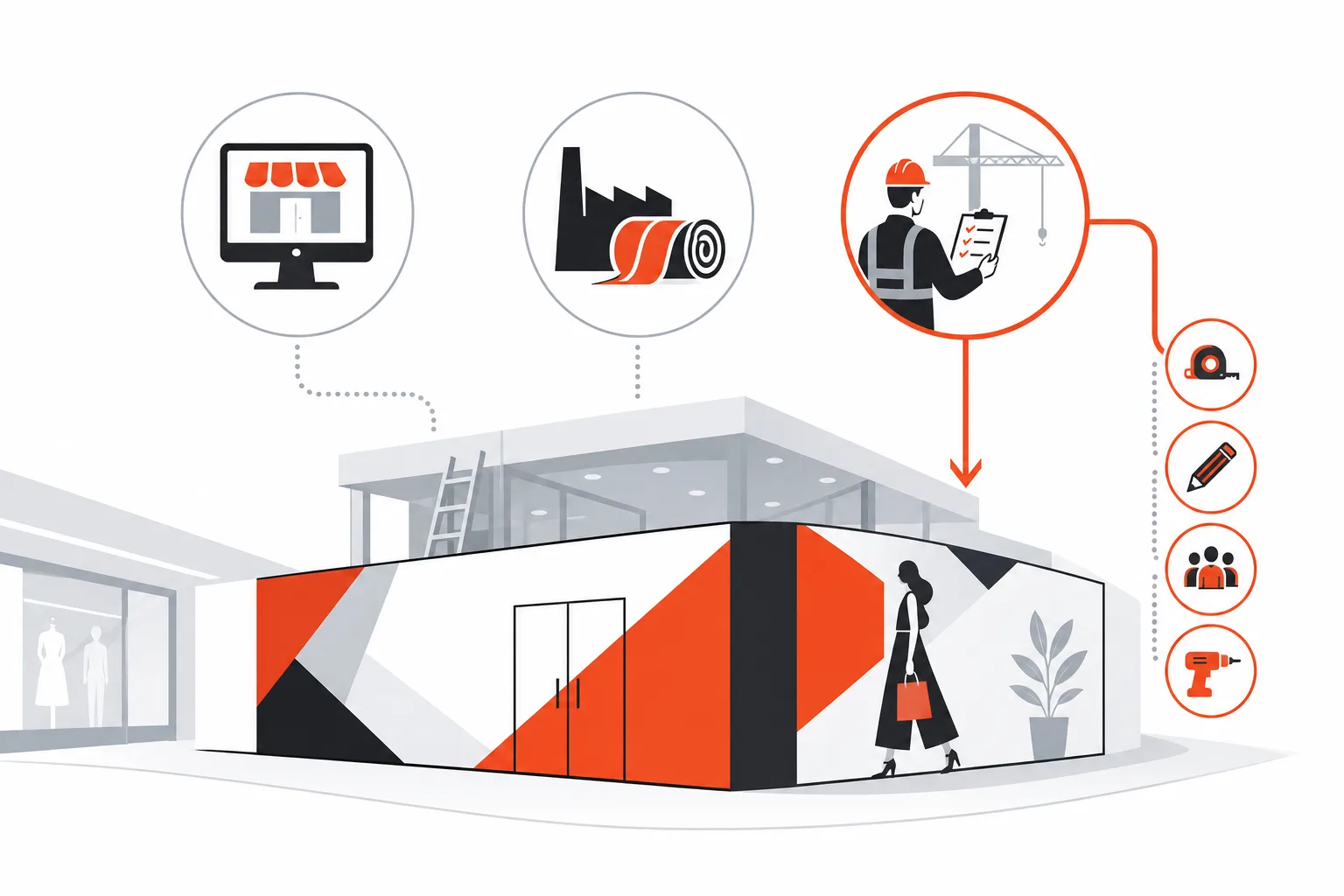
AmGraph Group (California) is a retail design and storefront graphics firm. Amgraph Packaging (Connecticut) makes flexible packaging. They share a name and nothing else. Full-service hoarding vendors handle print, installation, and mall coordination under one roof. This article clarifies what each vendor type does and which one fits a hoarding project.
Amgraph Group, Amgraph Packaging, and Full-Service Hoarding Vendors: What Each Actually Does
The name "Amgraph" points to two unrelated businesses, and conflating them leads to wasted outreach. The AmGraph Group, operating through its retail division AGRetail, is a California-based firm focused on retail design, implementation, and storefront graphics for North American retailers. Amgraph Packaging is a Connecticut manufacturer specializing in flexible packaging, stand-up pouches, and flexographic printing. If you are sourcing construction hoarding, Amgraph Packaging is not relevant to your search.
Full-service hoarding vendors occupy a different category. They manage the complete construction barrier process: site survey, artwork production, large-format print, and coordinated installation inside a mall environment. A blank plywood barrier signals vacancy. A printed, brand-accurate hoarding panel signals a store opening, and that distinction matters to leasing teams and brand managers alike.
Comparison Table: AmGraph Group vs Full-Service Hoarding Vendors
The table below compares the three vendor types across the criteria that matter most for a hoarding project. Pay particular attention to lead times and coordination capabilities when a store opening date is fixed.
| Vendor | Primary Service | Geographic Reach | Lead Time | Mall Coordination | Pricing Transparency |
|---|---|---|---|---|---|
| AGRetail / AmGraph Group | Retail design, storefront graphics, HDClear window films | Nationwide (North America) | Not publicly stated | Concept-to-completion project management | Not publicly listed |
| Amgraph Packaging | Flexible packaging, flexographic printing | Not specified | Not publicly stated | Not applicable | Not publicly listed |
| Rapid Retail Graphics | Full-service hoarding: survey, print, installation | United States and Canada | 1 to 5 business days from artwork approval | Coordinates with mall operations and security; installs outside trading hours | From about $6/sq ft; confirmed after site photo and drawing review |
Production costs for printed and installed construction hoarding systems typically range between $10 and $40 per square foot, per BillboardGuide's 2026 data. Where a vendor falls within that range depends on substrate, panel count, and whether installation and coordination are included.
What Is the Amgraph Group and What Services Does It Offer?
AGRetail is the retail-facing division of The AmGraph Group and provides concept-to-completion project management for major retailers across North America. Its core service lines cover retail design, in-store implementation, and storefront graphics, including HDClear window films applied to storefronts and display surfaces. The firm works with large retail chains that need consistent visual execution across multiple locations.
AGRetail's strength is broad retail graphics execution. If your project involves window graphics, in-store signage, or a full retail environment rollout, its scope fits. Based on its public materials, the firm positions itself as a nationwide implementation partner rather than a construction-barrier specialist.
For hoarding-specific projects, the scope is the limitation. AGRetail's service model is built around retail environments, not around the specific requirements of mall construction barriers: landlord approval packages, lease-line panel sizing, installation coordinated with mall security, and compressed timelines tied to a handover date. Those requirements call for a vendor whose entire process is built around them. For a direct comparison, see our AmGraph Retail comparison and the AmGraph Group alternatives guide.
Amgraph Packaging is worth naming only to dismiss from this comparison. Its SQF-certified Connecticut facility produces food-grade flexible packaging. It has no overlap with retail hoarding or storefront graphics.
What Does a Full-Service Hoarding Vendor Handle End to End?
A full-service hoarding vendor takes responsibility for every step between a signed lease and a finished construction barrier. That scope matters because each step is a coordination risk when it falls to a different party.
The process starts with a site survey and panel measurements. The vendor confirms exact dimensions at the lease line, accounts for cutouts or structural obstructions, and produces artwork adapted to those specific panel layouts. Large-format print follows, using substrates suited to high-traffic mall environments. Installation comes last, scheduled with mall operations and security, typically outside trading hours — see our process.
Rapid Retail Graphics is a full-service hoarding specialist that covers this entire scope for mall landlords, leasing teams, and retail brands across the United States and Canada. The company works from existing brand files or adapts campaign creative to hoarding panel layouts, and its standard turnaround is 1 to 5 business days from artwork approval. Landlords can see how this scales in our mall landlord hoarding program.
That lead time matters most when a store opening date is fixed and the hoarding needs to be in place before fit-out begins. A vendor that handles only print, or only installation, adds handoff points that compress the available timeline further.
What Is the Average Cost Per Square Foot for Printed Hoarding Graphics?
Printed and installed construction hoarding typically costs between $10 and $40 per square foot, according to BillboardGuide's 2026 report. The wide range reflects real variation: substrate choice, panel count, site complexity, and whether installation and mall coordination are bundled or billed separately all move the number.
That is an industry-wide range, not our pricing. Rapid Retail Graphics' typical benchmark is about $6 per square foot for print and standard installation, with final pricing confirmed after a site review — see pricing and turnaround and what per-square-foot pricing includes.
The lower end of the industry range generally applies to straightforward single-location projects with standard substrates and no complex installation requirements. The upper end reflects larger programs, premium materials, or sites with access restrictions that add coordination time and cost.
Cost-per-square-foot is a useful starting point, but it is not the full picture. A vendor that charges less for print but excludes installation coordination may cost more in total once you account for the time your team spends managing the gap. Confirm what is included before comparing figures across vendors.
How Does Branded Retail Hoarding Impact Store Opening Day Foot Traffic?
A construction barrier carrying brand graphics does more than cover a fit-out. It functions as a billboard-scale announcement at the exact location where the store will open, reaching shoppers who are already in the mall and already in a buying mindset.
The global temporary perimeter fencing market reached $4.87 billion in 2025 and is projected to grow 7.9% in 2026, which reflects how seriously retail and construction sectors are treating the perimeter as a media surface. For retail grocery specifically, shifting advertising budgets to a 27% allocation in out-of-home media can increase return on ad spend by 6%, according to a 2023 OAAA study. Hoarding sits within that OOH category.
Brand managers who treat the construction period as dead time miss a window. A blank barrier signals delay. A branded one signals arrival.
How to Choose Between AmGraph Group and a Full-Service Hoarding Vendor
Use this checklist to match your project to the right vendor type. AGRetail fits some of these scenarios; a full-service hoarding specialist fits others.
Choose AGRetail / AmGraph Group if:
- Your project centers on storefront window graphics, in-store signage, or a broader retail environment rollout
- You need a nationwide retail implementation partner across multiple store formats
- Construction barriers are a minor component of a larger retail graphics program
Choose a full-service hoarding vendor if:
- You need printed construction barriers installed at a mall lease line on a fixed opening timeline
- Your landlord requires a coordinated installation outside trading hours
- You are managing multiple locations and need consistent brand execution across all of them
- Your lead time is under two weeks from survey to installed panels
Before engaging any vendor, identify the market, production scope, and current pricing for the site. Then verify physical panel dimensions and any cutouts before finalizing artwork design. Those two steps prevent the most common delays regardless of which vendor type you use.
Frequently Asked Questions
Are AmGraph Group and Amgraph Packaging the same company?
No. The AmGraph Group is a California-based retail design and storefront graphics firm operating under the AGRetail brand. Amgraph Packaging is a Connecticut-based flexible packaging manufacturer specializing in food-grade pouches and flexographic printing. The two companies share a name but operate in entirely different industries with no overlapping services.
What materials are typically used for printed construction hoarding in high-traffic malls?
Most printed hoarding uses pressure-sensitive vinyl films or PVC-based substrates applied to plywood or composite panels. The specific material depends on the landlord's requirements, the expected duration of the fit-out, and the level of foot traffic at the site. Vendors confirm substrate selection after reviewing site conditions and the landlord's approval requirements.
Can a retail graphics vendor handle hoarding if they don't specialize in construction barriers?
A general retail graphics vendor can produce printed panels, but may not handle the full scope: site survey, landlord approval coordination, installation outside trading hours, and sign-off with mall operations and security. If those steps fall to your team, you absorb the coordination risk and the time cost. Confirm exactly what the vendor's scope covers before committing.
How far in advance should a leasing team engage a hoarding vendor before a store opening?
As early as possible, but a specialist hoarding vendor with a 1 to 5 business day turnaround from artwork approval can work within tight windows. The practical constraint is usually landlord approval, not production. Engaging the vendor before the handover date is confirmed gives you the most flexibility on artwork revisions and installation scheduling.
What information does a hoarding vendor need before producing artwork?
At minimum: site photos, panel dimensions at the lease line, any structural cutouts or obstructions, the landlord's substrate and installation requirements, and your existing brand files or campaign creative. Some vendors conduct their own site survey and gather this information directly. Confirming who is responsible for the survey is the first question to ask.
Conclusion
AmGraph Group and Amgraph Packaging are two separate companies. Neither is a dedicated construction hoarding specialist. If your project involves printed barriers at a mall lease line, you need a vendor whose entire process is built around survey, print, mall coordination, and installation on a fixed timeline. That is a different service category from retail storefront graphics or flexible packaging.
Start by confirming whether your project is primarily a hoarding program or a broader retail graphics rollout. If it is hoarding, verify panel dimensions and landlord requirements before you brief any vendor. Those two steps define the scope you need to ask for, and which vendor type can actually deliver it. Request a quote when you're ready.
Have a hoarding project coming up?
Get a Quote