2026-10-07
Hoarding Graphics Per Square Foot: What the Pricing Includes
By Bryce Mitchell — Founder, Rapid Retail Graphics
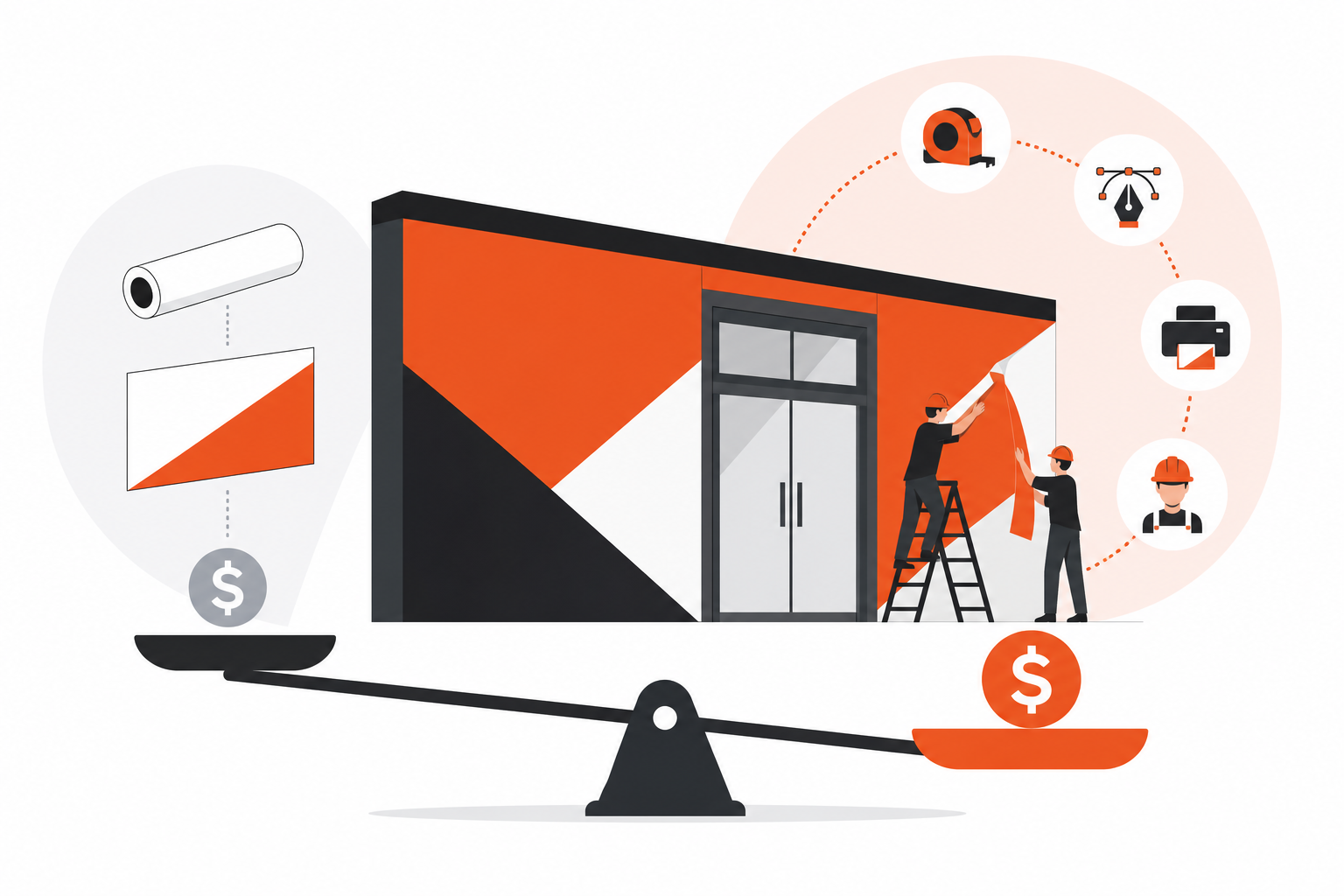
Vinyl hoarding graphics per square foot pricing covers a wider range than most budget templates account for, because print-only and full-service quotes look similar on paper but include very different scopes. Final pricing depends on barrier size, artwork complexity, and location.
The rest of this article breaks down what drives that number and how to compare quotes accurately.
Hoarding Graphics Per Square Foot Pricing: Print-Only vs. Full-Service
The scope behind the number matters as much as the number itself. Vinyl hoarding graphics per square foot pricing falls into two categories: print-only and full-service, and comparing them at face value is one of the most common budgeting mistakes on retail construction projects.
A print-only quote covers large-format production of the graphic panels. You receive finished vinyl, ready to apply. Everything after that—coordinating access with mall operations, scheduling an installation crew, and managing after-hours logistics—falls to you.
A full-service quote covers site survey and laser measurements, artwork adaptation to your specific panel dimensions, large-format print on fire-rated vinyl with a protective laminate, and coordinated on-site installation outside trading hours.
Only a full-service quote eliminates the coordination overhead that does not show up as a line item.
Use the instant estimate calculator to get a working number before a formal quote conversation.
How to Calculate Your Hoarding Graphics Cost
Barrier size is the starting point for any hoarding graphics budget. A standard 20-foot mall run equals 200 square feet of printable surface, and a fully installed graphic for that barrier costs approximately $1,200. From there, the math scales with linear footage and panel height, typically 8 to 10 feet in most mall environments.
For a broader look at how project size, timeline, and scope interact with cost, the retail hoarding graphics cost and timeline guide covers the full picture.
The table below shows common barrier sizes, approximate installed costs, and the retail scenarios they typically correspond to. Cost figures reflect full-service scope and are approximate. Artwork adaptation and site-specific access requirements may affect the final figure.
| Barrier size | Approx. installed cost | Typical use case |
|---|---|---|
| 200 sq ft (20-ft run) | Approx. $1,200 | Standard inline store, single-bay fit-out |
| 300 sq ft | Scales proportionally | Mid-size inline or corner unit |
| 500 sq ft | Scales proportionally | Larger inline, end-cap, or kiosk surround |
| 800 sq ft | Scales proportionally | Junior anchor or multi-bay renovation |
| 1,200+ sq ft | Scales proportionally | Major anchor, food hall, or flagship build-out |
What Drives the Final Price? Key Cost Variables
Several variables move the per-square-foot rate up or down. Understanding them helps you evaluate quotes from any vendor and identify where your project sits on the cost spectrum.
- Barrier size. Total square footage is the primary driver. A larger barrier means more print area, more installation time, and more crew coordination.
- Artwork complexity. Production-ready files sized to your panel layout add minimal cost. Campaign assets that need adaptation, retouching, or rebuilding for large-format output add more. The plain-language guide for brand teams and leasing staff covers what file formats and dimensions to prepare. For property managers, the retail property manager guide outlines what to expect at each stage.
- Substrate type. Standard fire-rated vinyl suits most mall environments. Specialty substrates like Sintra PVC or Coroplast may be required for certain structural applications and carry different material costs.
- Rush scheduling. Standard turnaround is 1 to 5 business days from survey to installed graphics. Compressed timelines may affect the final quote.
- After-hours access. Installation outside trading hours is standard for occupied malls. Properties with strict access windows or multiple security checkpoints can add crew time.
- Multi-location rollouts. A single-store project and a ten-store program are quoted differently. Volume affects production costs and coordination logistics.
Standard Lead Times: How Long Does Installation Take?
From site survey to completed installation, the standard window is 1 to 5 business days. That covers the full sequence: laser measurements, artwork adaptation, production proof and client approval, print and laminate, and on-site installation.
Installation is typically scheduled outside trading hours to meet mall operations requirements. Properties with limited overnight access windows or multiple approval stages can extend that timeline. Rush options are available when lease handover dates compress the schedule.
For a detailed look at what each stage involves operationally, the 2026 guide to installing branded construction barriers in a mall covers the six-stage process from survey to sign-off.
Why Full-Service Quotes Often Cost Less in Total
A print-only vendor delivers the panels. Everything after that falls to you: sourcing an installation crew, coordinating access with mall operations, managing after-hours logistics, and handling any compliance documentation the landlord requires. For multi-location programs or tight opening timelines, that coordination overhead compounds quickly.
Some vendors, like AMGraph Retail, BlastMedia, and Craftsmen Industries, offer print production but do not publicly detail installation capabilities for mall environments, per rapidretailgraphics.com. A single-vendor model that covers survey, artwork, print, and installation under one quote removes the coordination layer entirely.
Rapid Retail Graphics is a full-service hoarding graphics vendor that manages site survey, artwork adaptation, large-format print, and coordinated on-site installation across the United States and Canada.
Get a Quote for Your Hoarding Graphics Project
The fastest way to get a number is to send over your site photos and square footage. Send over your site photos and square footage and most quotes come back the same day. If you are earlier in the planning process, the estimate calculator gives you a working figure before you have drawings.
FAQs
Does the per-square-foot price include installation?
It depends on the vendor and the quote. A print-only quote covers production only. A full-service quote covers site survey, artwork adaptation, print, and coordinated on-site installation. Always confirm scope before comparing figures. A lower per-square-foot rate that excludes installation can end up costing more once you account for sourcing and coordinating a separate crew.
What is not included in the base hoarding graphics price?
Structural hoarding panels or framing are typically supplied by the general contractor or landlord, not the graphics vendor. Rush premiums, specialty substrates, and site-specific access requirements that add crew time are quoted separately based on project details.
Can I get a quote before providing detailed drawings?
Yes. Site photos and square footage are enough to generate a working estimate. Final pricing is confirmed after a review of drawings and any landlord-specific requirements, but you do not need a full set of construction documents to start the conversation.
Do prices differ by city or region?
Location can affect pricing, primarily through after-hours access requirements, crew scheduling logistics, and any travel or market-specific costs. The base scope—survey, artwork, print, and installation—is consistent across markets in the United States and Canada.
How much does a typical retail hoarding project cost in total?
Barrier size and full-service scope are the two biggest factors in total project cost. Larger barriers scale from the base rate based on square footage, artwork complexity, and any site-specific requirements.
Conclusion
Hoarding graphics per square foot pricing means different things depending on what the quote includes. A print-only rate and a full-service rate can look similar on paper, but only one of them covers site survey, artwork adaptation, and coordinated installation. Knowing the scope behind the number is what makes a budget line defensible.
Before you request quotes, confirm the barrier dimensions, check whether your brand files are production-ready, and ask each vendor directly whether installation and landlord coordination are included. Those three questions will tell you more about the true cost of a project than the per-square-foot figure alone.
Have a hoarding project coming up?
Get a Quote