2026-09-23
AmGraph Group Alternatives for Full-Service Mall Hoarding
By Bryce Mitchell — Founder, Rapid Retail Graphics
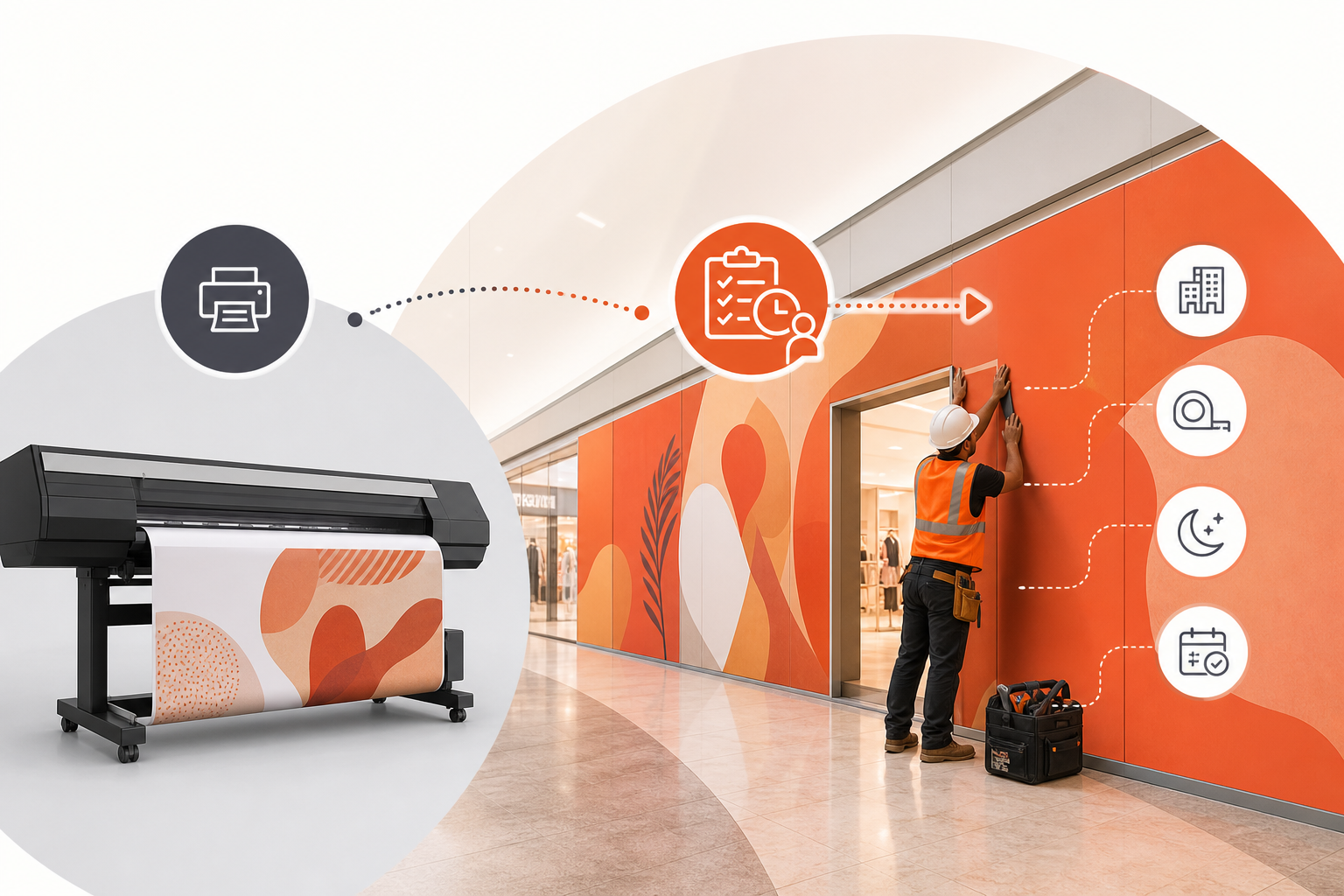
You have a lease signed, a handover date on the calendar, and a hoarding barrier that needs to go up before the mall opens. You search for vendors. The AmGraph Group comes up. So does a short list of other names.
This article covers what to look for when evaluating AmGraph Group alternatives specifically for mall hoarding — not general large-format graphics, not window film, not floor decals. Mall hoarding. Survey to installed wall, coordinated with mall operations, on a retail construction timeline.
What the AmGraph Group Actually Does
The AmGraph Group is a broad-scope graphics company. Their work spans large-format print, retail environments, vehicle wraps, wall graphics, and construction barricades. They serve national retail clients across multiple format types, which gives them a wide portfolio and established relationships with brands that need more than one format type handled at once.
That breadth is also the limitation when your project is specifically a hoarding installation in a mall.
From publicly available information, AmGraph operates primarily as a print and graphics production company. Installation is part of some projects. What isn't documented on their site: a published turnaround commitment for hoarding installs, a per-square-foot price, or a process built specifically around mall construction timelines and landlord approval requirements.
If you're a leasing coordinator managing a single-location renovation with a three-week window, that missing information matters before you spend time on a discovery call.
Why Mall Hoarding Requires a Different Kind of Vendor
Not every large-format graphics company is built for mall hoarding. The format looks similar — printed panels on a barrier — but the operational requirements are different from a retail window graphic or a trade show display.
Mall hoarding involves:
- Landlord approval packages — most major mall landlords require submitted artwork, panel layouts, and substrate specs before installation can proceed. Cadillac Fairview, Oxford Properties, Ivanhoe Cambridge, and Simon all have their own requirements. A vendor unfamiliar with this process adds weeks to your timeline.
- After-hours installation access — mall operations teams restrict contractor access to outside trading hours. A vendor who doesn't coordinate with mall security and operations creates scheduling conflicts that delay your install.
- Accurate site measurements — hoarding panels are cut to the lease line. Wrong measurements mean panels that don't fit, gaps at the corners, or substrate that runs past the permitted area. A site survey before production is not optional.
- A fixed opening date — unlike a trade show, you can't push the date. The store opens when it opens. Your vendor's timeline is your timeline.
A generalist graphics company can produce the print. Whether they can manage the full process — survey, artwork adaptation, landlord submission, after-hours install — is a different question.
The Vendor Coordination Problem
Most leasing coordinators aren't managing just the hoarding vendor. They're tracking the general contractor, the landlord approval process, brand team sign-off on artwork, and the opening date simultaneously.
When your print company and install crew are separate vendors, you absorb the gap between them. Graphics arrive late — the install gets pushed. The install crew has a scheduling conflict — the graphics sit in a warehouse. Either way, you're the one managing it, and the opening date doesn't move.
This is the core problem with using a production-focused vendor for a mall hoarding project. You get the print. You still need to source the installer, confirm their mall access credentials, coordinate their schedule with mall operations, and verify the work meets landlord spec. That falls to you.
A single vendor who owns survey, artwork, print, and installation removes that gap entirely.
What to Look for in an AmGraph Group Alternative
When evaluating alternatives to the AmGraph Group for mall hoarding specifically, these are the criteria that separate a capable vendor from one that creates problems mid-project.
Published turnaround commitment
Does the vendor state a lead time publicly? A vendor who won't commit to a timeline before the first call is telling you something about how they operate. For mall hoarding, 3 to 5 business days from survey to installed wall is a reasonable benchmark for a specialist.
Full scope under one roof
Survey, measurements, artwork production, print, and installation — handled by one team. Not a print shop that subcontracts install. Not a broker coordinating between vendors. One point of contact who owns the outcome from start to finish.
Mall operations coordination
Can the vendor coordinate directly with mall security and operations for after-hours access? Have they worked within the approval processes of major landlords? This is where generalist vendors most often fall short.
Artwork adaptation from existing files
If you're working with a brand that has existing campaign creative, the vendor needs to adapt that creative to hoarding panel layouts without losing brand fidelity. That's a different skill set from producing original artwork. Confirm they can work from your files.
Transparent pricing before a call
Can you get a meaningful estimate before committing time to a vendor conversation? An online calculator or a published per-square-foot rate tells you whether the vendor fits your budget before either party invests time.
Other Vendors in the Space
Beyond the AmGraph Group, a few names come up regularly when leasing coordinators search for mall hoarding vendors.
SpeedPro
SpeedPro operates a nationwide franchise network, which gives them geographic reach. The franchise model also produces inconsistent service quality across locations — the SpeedPro in one city may operate very differently from the one in another. It's a generalist wide-format print operation; hoarding is one of many format types they handle, not a core specialization. Pricing varies by franchise location.
Blast Media
Blast Media positions specifically for luxury retail hoarding at premium locations, including Yorkdale Shopping Centre. If your project is a luxury brand at a flagship mall, they're worth evaluating. Their luxury-only positioning and Canada-based operation make them a poor fit for mid-market retail programs or US locations.
AGRetail
AGRetail specializes in retail and mall barricade graphics and has a strong portfolio. They're California-based, which limits geographic reach for projects outside the West Coast. They don't advertise a comparable turnaround commitment or a site survey service.
Boston Retail Solutions
Boston Retail Solutions focuses on modular reusable barricade hardware rather than graphics production. If your project requires a permanent or semi-permanent barrier system, they're relevant. For a standard hoarding graphics program, they're a different product category.
Craftsmen Industries
Craftsmen Industries is a broader retail graphics and installation company. Hoarding is not their primary specialization. If you're evaluating them alongside other alternatives, the Craftsmen Industries alternatives guide for mall hoarding covers the comparison in detail.
Rapid Retail Graphics as an Alternative
Rapid Retail Graphics is a hoarding graphics specialist. The scope is specific: site survey, measurements, artwork production, large-format print, and coordinated on-site installation — handled by one team across North America.
The published rate is approximately $6 per square foot, inclusive of print and standard installation, with final pricing confirmed after reviewing site photos and drawings. Turnaround runs 3 to 5 business days from survey to installed wall, with rush options available when the timeline is tighter.
Installation is scheduled outside trading hours. The team coordinates directly with mall operations and security — which eliminates one of the most common reasons hoarding installs get delayed or rejected. That coordination extends to the approval processes of landlords including Cadillac Fairview, Oxford Properties, Ivanhoe Cambridge, and Simon.
If you're working with an existing brand campaign, the team adapts your creative to hoarding panel layouts. You don't need to rebuild artwork from scratch or hire a separate designer to reformat files.
Typical project budgets run from $5,000 to $30,000 depending on linear footage and configuration. An instant estimate calculator is available at rapidretailgraphics.com — no call required to get a number you can take to your project manager.
For a direct comparison of how Rapid Retail Graphics and AmGraph Retail approach mall hoarding differently, the Rapid Retail Graphics vs. AmGraph Retail comparison covers scope, pricing transparency, and turnaround side by side.
When the AmGraph Group Still Makes Sense
AmGraph may be the right call if your project is a large, multi-format retail rollout where hoarding is one component of a broader graphics program. If you need window graphics, floor decals, wall wraps, and a construction barrier all produced under one umbrella, a broader-scope company makes sense.
They also appear to have established relationships with national retail clients. If a brand you're working with already uses AmGraph for other format types, extending that relationship to hoarding could reduce vendor onboarding time.
The tradeoff: you may not get a hoarding-specific process, a published timeline, or a price you can take to your project manager before the first call. For a project where the opening date is fixed and the hoarding install is on the critical path, that uncertainty is a real risk.
Making the Decision
The decision comes down to what your project actually requires.
If hoarding is one item on a long list of format types and you have time to manage coordination between print and install, a broader graphics company may work. If hoarding is the primary deliverable, the timeline is tight, and you need one vendor to own the outcome from survey to installed wall — that's a different requirement.
Ask every vendor you're evaluating the same three questions:
- What is your published turnaround from survey to installation?
- Do you coordinate directly with mall operations for after-hours access?
- Can I get a price estimate before our first call?
The answers tell you quickly whether you're talking to a hoarding specialist or a generalist who handles hoarding as a secondary format type.
Get an instant estimate at rapidretailgraphics.com before you've committed any time.
Frequently Asked Questions
Have a hoarding project coming up?
Get a Quote