2026-05-04
Hoarding Graphics for Store Openings: How to Avoid the Most Expensive Mistakes
By Sarah Mitchell — Visual Merchandising Specialist
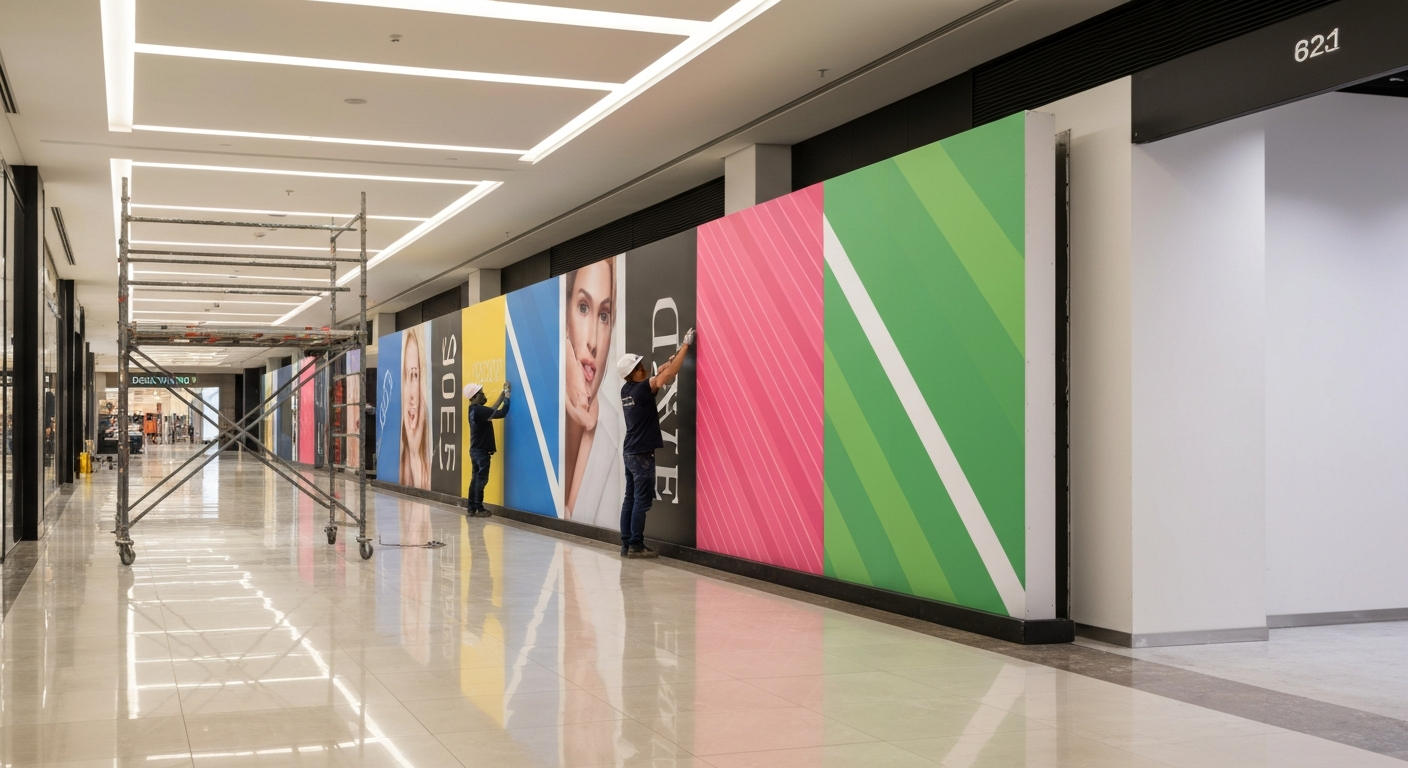
You've secured the lease, construction is underway, and the opening date is set. The hoarding graphics feel like the easy part. They're not.
Retail graphics for store openings sit at the intersection of brand standards, landlord approvals, print production timelines, and mall access rules. Miss any one of those, and you're looking at bare plywood on opening day, a reprint you didn't budget for, or a compliance issue that stalls the install entirely.
The mistakes that cause these problems are predictable — and avoidable, if you know where they happen.
Mistake 1: Ordering Without a Site Survey
Inaccurate measurements are the most common source of expensive reprints. A hoarding wall in a mall is rarely a clean rectangle. You'll encounter angled returns, column offsets, door frames, fire hose cabinets, and panel seams — all of which affect how graphics need to be sized and laid out.
Order based on lease drawings or rough dimensions, and the panels that arrive on-site won't align. Re-printing and re-shipping costs time and money. Worse, it usually means the barrier goes up bare while you wait for the corrected run.
A proper site survey eliminates this entirely. The brief-and-survey step should happen the same or next business day after a project is confirmed — measurements captured before artwork is templated, not after. The full breakdown of what a site survey actually covers is a useful reference before you brief any vendor.
Mistake 2: Using a General Print Shop Unfamiliar With Mall Requirements
A vendor unfamiliar with mall environments will either delay the job or trigger a compliance issue that forces a redo. This isn't a knock on general print shops. It's a structural problem: hoarding graphics in retail malls carry requirements that most commercial print work simply doesn't.
Landlords like Cadillac Fairview, Oxford Properties, and Ivanhoé Cambridge each maintain their own hoarding graphic standards. These typically cover substrate specifications, finish requirements (matte laminate is common; gloss is often rejected), minimum print resolution, and panel mounting methods. Some require formal artwork approval before any installation can be booked.
A vendor navigating these requirements for the first time will learn on your project. That learning has a cost, and it usually shows up as a delay or a non-compliant install.
For more on what landlord compliance actually involves, the property-by-property breakdown of CF, Oxford, and Ivanhoé Cambridge requirements covers the specifics in detail.
Mistake 3: Submitting Artwork Too Late in the Process
Most retail teams understand that print takes time. What gets underestimated is how much time the artwork stage consumes before print even begins.
Brand files built for digital or traditional advertising rarely translate directly to hoarding layouts. Aspect ratios are different. Resolution requirements are different. The way a campaign image crops across a 40-foot wall is a design problem, not a print problem. If your creative team is adapting files to the hoarding layout, that work needs to happen early — early enough that revisions don't compress the production window.
A 1 to 5 business day turnaround from final artwork approval to installation is achievable. But that clock starts only when print-ready files are confirmed. If artwork approval takes two weeks, your opening date doesn't move to accommodate it.
Build the artwork handoff into your project timeline from the start, not once construction milestones are hit. The 5 mistakes retailers make with hoarding graphics during fit-outs goes deeper on how artwork delays compound across a fit-out schedule.
Mistake 4: Ignoring Mall Operations and Access Protocols
Getting the graphics printed is one thing. Getting them installed is another.
Most malls require a formal contractor access request at least 48 to 72 hours in advance. Some require certificates of insurance tied to the specific property. Many restrict installation work to outside of trading hours, which means overnight or early-morning installs. A vendor who hasn't coordinated with mall security and operations before will find out about these requirements when they show up at the loading dock and get turned away.
A failed access attempt doesn't just delay the install by a day. It can push the booking to the next available overnight window — which may be days out depending on the mall's schedule.
The full guide to coordinating hoarding graphic installs with mall security and operations covers what this coordination actually involves and what to confirm before any install is scheduled.
Mistake 5: Treating Hoarding Graphics as Set-and-Forget
A hoarding goes up, the construction crew moves in, and the graphics get forgotten. That's a missed opportunity with a real cost.
If your fit-out runs longer than expected, the creative on that hoarding may be promoting a campaign that's already ended, an opening date that's already passed, or a brand look that's since been updated. Shoppers walking past that wall every day are forming an impression of your brand based on stale retail graphics.
A refresh doesn't require a full reprint. In many cases, updating key panels or swapping date-specific messaging is straightforward — if the original install was done with that possibility in mind. The hidden costs of getting hoarding graphics wrong breaks down what a set-and-forget approach actually costs over the life of a fit-out.
If you're managing multiple locations, the problem compounds. Inconsistent or outdated creative across a retail chain creates brand inconsistency that's hard to walk back. The guide to multi-location hoarding graphics for Canadian retail chains addresses how to keep creative consistent and current across several sites at once.
What a Tight, Reliable Retail Graphics Process Looks Like
When a store opening goes smoothly from a graphics standpoint, it's because the process was structured correctly from the start. That means:
- A site survey completed before any artwork is templated
- Artwork adapted to the actual hoarding dimensions, not the other way around
- Mall landlord requirements confirmed before production begins
- Mall operations and security access coordinated before the install date is locked
- A clear plan for refreshing or updating panels if the fit-out timeline extends
None of this is complicated, but it requires a vendor who has done it before and knows where the friction points are. Rapid Retail Graphics handles all of these steps as part of a full-service project, including installs coordinated outside of trading hours with photo proof on completion. If you're working toward a specific opening date, the pricing and process overview gives you a starting point for scoping the work.
FAQs
The Short Version
The mistakes that derail hoarding graphics for store openings aren't random. They happen at predictable points: skipped site surveys, unfamiliar vendors, late artwork handoffs, ignored access protocols, and graphics left up long past their relevance.
Each one has a straightforward fix — a process that accounts for all of them before the project starts, not after something goes wrong.
Planning a store opening? Get an instant estimate or request a detailed quote — or call (604) 220-7700 to scope the project before you commit to a date.
Have a hoarding project coming up?
Get a Quote