2026-09-30
Mall Fit-Out Vendor: What One Partner Handles vs Multiple
By Bryce Mitchell — Founder, Rapid Retail Graphics
You have a lease signed. The handover date is on the calendar, the fit-out clock is running, and somewhere between now and opening day, hoarding panels need to go up, get approved by mall operations, and look exactly like the brand intended.
The question every leasing coordinator and retail construction manager faces at this point is the same: do you coordinate multiple vendors, or do you hand the entire scope to one team?
Both approaches work — until they don't. This article breaks down what each model actually requires from you, where each one breaks down, and how to decide which fits your project.
What "Full-Service" Actually Means for a Mall Fit-Out
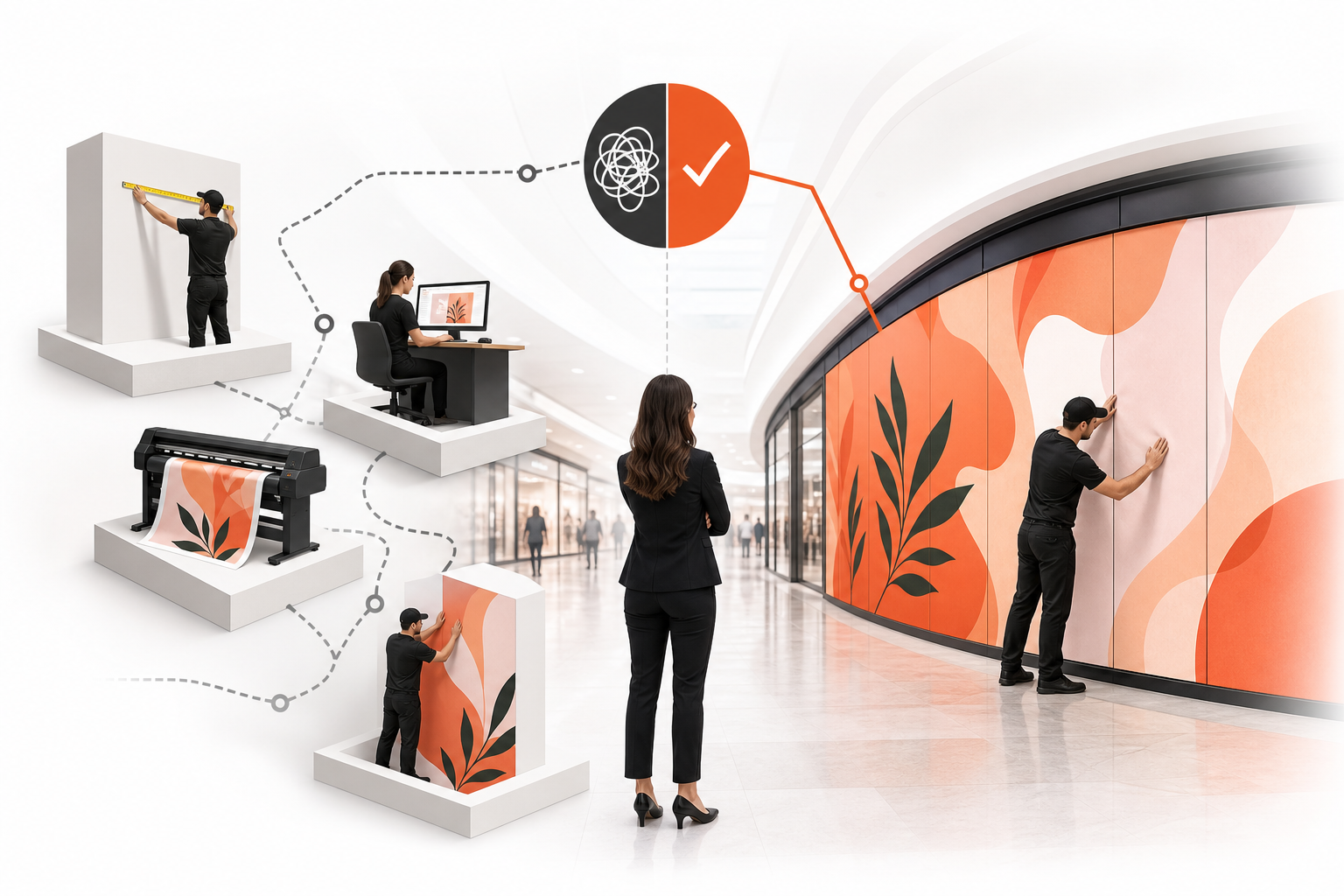
Full-service means one vendor owns every step from site survey through signed-off installation. No handoffs between a measurement company, a design studio, a print shop, and a separate install crew. One point of contact, one timeline, one accountability chain.
For hoarding graphics specifically, full-service covers:
- Site survey and measurements — physical dimensions of the lease line, substrate conditions, any landlord-specified constraints
- Artwork template production — adapting your brand files or campaign creative to the actual panel layout
- Large-format print production — printing to the correct substrate for the landlord's spec
- On-site installation — coordinated with mall operations, typically outside trading hours
When all four steps live under one vendor, the project moves in a straight line. When they're split, you become the project manager.
The Multi-Vendor Model: What It Actually Requires
Splitting the scope across vendors isn't inherently wrong. Some projects call for it. But you need to understand what you're taking on.
You own the measurement-to-artwork handoff
The measurement company gives you dimensions. You pass those to the design studio. If the dimensions are wrong, or the template doesn't account for panel seams, the artwork comes back unusable. That revision cycle costs days, not hours.
You own the artwork-to-print handoff
The design studio delivers files. You send them to the print shop. If the files aren't print-ready — wrong colour profile, missing bleed, incorrect resolution — the print shop either flags it and waits for corrections, or prints and charges you for a rerun. Either way, the timeline slips.
You own the print-to-install coordination
The print shop ships panels. The install crew needs to be on-site during an approved mall operations window. If the panels arrive late, or the install crew isn't cleared by mall security, the window closes. The next available window might be three days out. That's three days off your opening date.
You own every approval package
Mall operators — whether you're dealing with Cadillac Fairview, Oxford Properties, Simon, or Ivanhoe Cambridge — require approval before installation begins. Landlord approval packages typically include artwork proofs, substrate specifications, and install method documentation. With multiple vendors, assembling that package falls to you.
That's the brief when you split the scope. It's manageable if you have the bandwidth and the relationships. It becomes a problem the moment any one vendor misses a deadline or misreads the spec.
The Single-Vendor Model: What It Removes From Your Plate
When one vendor handles the full scope, the coordination burden shifts entirely. You provide the location, the project dates, and your brand files. The vendor handles the rest.
A single-vendor model removes:
- The measurement-to-artwork handoff (the vendor does both)
- The artwork-to-print handoff (same team, same timeline)
- The print-to-install coordination (the vendor books the mall operations window)
- The approval package assembly (the vendor knows what each landlord requires)
What you're left with is a review and sign-off role, not a project management role. For a leasing coordinator running multiple fit-outs simultaneously, that distinction matters.
The risk profile changes too. With multiple vendors, a failure at any handoff point is your problem to diagnose and fix. With a single vendor, the failure is theirs to resolve — and a vendor with a 1 to 5 business day average lead time from survey to install has a strong incentive to keep every step on schedule.
Where Each Model Makes Sense
Use a single-vendor model when:
- You have a fixed opening date with no float
- You're managing multiple locations simultaneously
- The landlord's approval process is strict and time-sensitive
- Your brand files need adaptation, not just reproduction
- You don't have a dedicated project manager for the hoarding scope
Consider a multi-vendor model when:
- You have significant lead time — six weeks or more — and internal project management capacity
- You have existing vendor relationships for each step that have proven reliable
- The project is a single location with a straightforward spec
- You need a specific substrate or installation method that only a specialist can provide
Most mall fit-out projects don't have six weeks of float. Most leasing coordinators are managing more than one project at a time. The single-vendor model is the default for a reason.
The Approval Window Problem
This is the specific failure point that multi-vendor models hit most often, and it's worth naming directly.
Mall operations approval windows are fixed. The landlord sets the hours during which installation can occur — typically overnight or early morning before the mall opens. Miss the window, and you wait for the next one.
A print shop that doesn't coordinate with mall operations won't know the window exists until you tell them. An install crew that isn't pre-cleared by mall security won't get on-site regardless of what the print shop shipped. These are coordination failures that happen at the seam between vendors, not within any single vendor's scope.
A vendor that handles installation as part of its core service — not as a subcontracted afterthought — builds the approval window into the project timeline from the start. Installation happens outside trading hours because that's how the vendor operates, not because you remembered to ask.
If you're evaluating vendors for a Canadian landlord project, the mall hoarding graphics vendor selection guide for leasing teams covers what to look for in that specific context, including landlord compliance requirements.
Multi-Location Programs: Where the Model Choice Is Most Consequential
A single-location fit-out is forgiving. If one vendor misses a step, you have time to recover.
A multi-location rollout is not. Twelve stores. Twelve mall landlords. Twelve sets of hoarding panels that all need to look like they came from the same campaign. If you're coordinating separate vendors at each location, you're running twelve parallel projects — and any one of them can delay the others if a supplier is shared.
A single vendor with North America coverage can standardize the process across all twelve locations. Same artwork templates, same print spec, same install protocol. The brand looks consistent because the process is consistent — not because twelve different teams happened to produce matching results.
For projects in specific markets, local compliance requirements add another layer. The hoarding graphics requirements for Vancouver mall projects illustrates how landlord specs vary by market and why a vendor with cross-market experience handles those variations more reliably than a local-only supplier.
What to Ask Any Vendor Before You Commit
Whether you're evaluating a single-vendor model or building a multi-vendor shortlist, these questions separate vendors who can handle a mall fit-out from those who can handle part of one:
- Do you conduct your own site surveys, or do you rely on client-supplied measurements?
- Do you adapt artwork to panel layouts in-house, or do you require print-ready files?
- Who coordinates the mall operations approval window — you or the client?
- Is installation performed by your own team or subcontracted?
- What is your average lead time from survey to completed install?
- What happens if the install window is missed?
A vendor that subcontracts installation, requires print-ready files, and asks you to coordinate the approval window is a print vendor, not a fit-out vendor. The distinction matters when your opening date is fixed.
Rapid Retail Graphics handles all four steps — survey, artwork, print, and installation — under one scope, with an average lead time of 1 to 5 business days and installation coordinated directly with mall operations. Pricing runs approximately $6 per square foot inclusive of print and standard installation, confirmed after reviewing site photos and drawings. You can get an instant estimate at rapidretailgraphics.com.
FAQs
Have a hoarding project coming up?
Get a Quote