2026-05-04
Hoarding Graphics in Vancouver: What Local Mall Projects Require in 2026
By Mike Torres — Senior Install Coordinator, 12+ Years in Retail Fit-Out
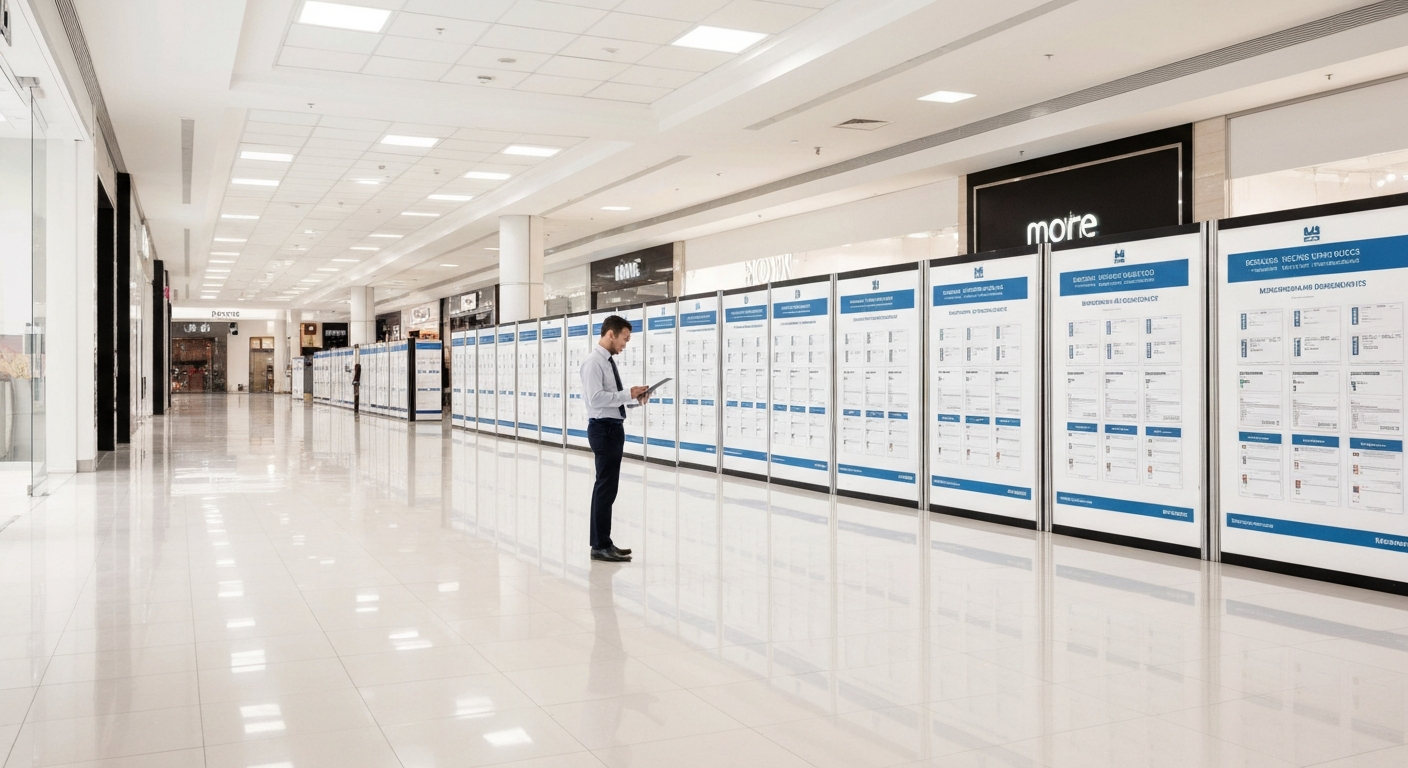
You know your lease start date. You probably have brand assets ready, or close to it. What you may not have is a clear picture of what Vancouver's mall operators actually require before a single panel goes up.
That gap is where projects stall. A vendor who treats retail hoarding as a standard print job will miss the approval steps, use the wrong substrate, or schedule an install during trading hours. Any one of those errors costs you days you don't have.
This article covers what Vancouver mall projects specifically require in 2026 — landlord approval workflows, materials, installation access — so you can plan accurately from the start.
Why Vancouver Mall Projects Have Specific Hoarding Requirements
Retail hoarding in a mall is not the same as hoarding on a street-level construction site. Mall operators control everything that goes into their common areas, and Vancouver's major centres are managed by some of the most process-driven landlords in Canada.
Your hoarding graphics need to clear multiple checkpoints before installation: design approval, materials sign-off, and a coordinated access window with mall operations and security. Miss any one of them and the job stops.
Vancouver also has a concentration of high-traffic, high-profile properties — Metropolis at Metrotown, Pacific Centre, Oakridge, Park Royal — where brand presentation standards are enforced strictly. A vendor without experience in these environments will either delay the job or trigger a compliance issue that forces a redo.
The Major Landlords and What They Expect
Cadillac Fairview Properties
Cadillac Fairview operates Pacific Centre in downtown Vancouver, one of the most active leasing environments in the country. Their hoarding approval process runs through their tenant coordination team, with a 5 to 7 business day review window that needs to be built into your schedule before installation can be booked.
Artwork must meet their specific template dimensions and include approved brand elements only. Any deviation — wrong logo version, unapproved campaign imagery, incorrect panel sizing — comes back for revision. That cycle adds days, sometimes more than a week if it lands during a busy period for their team.
Ivanhoé Cambridge and Oxford Properties
Ivanhoé Cambridge manages Oakridge Centre, which is in the middle of a major redevelopment phase in 2026. Oxford Properties operates Metropolis at Metrotown. Both run structured tenant coordination processes with dedicated contacts for hoarding approvals.
For active development zones like Oakridge, the requirements go beyond a standard fit-out scenario. Panel dimensions, fastening methods, and fire-rating specifications all need to be confirmed against the property's current construction management plan. The property-by-property landlord requirements guide breaks down exactly what each major Canadian landlord expects.
Site Surveys: Why You Cannot Skip This Step in Vancouver
Vancouver mall properties are not uniform. Pacific Centre has low-ceiling corridors with different panel height restrictions than Metropolis at Metrotown's wide concourse bays. Park Royal's indoor and outdoor sections have entirely different surface conditions and exposure requirements.
Quote from drawings alone and you will almost certainly hit a dimension discrepancy on install day. Panels that don't align at seams, gaps at floor or ceiling junctions, artwork that doesn't account for a column mid-hoarding — all of it is preventable with a proper on-site measurement visit.
A same-day or next-day site survey is standard practice for any project where accuracy matters. Rapid Retail Graphics collects site photos and measurements before artwork templating begins, so the panels produced match the actual wall. The site survey guide covers exactly what gets measured and why each step matters.
Artwork Approval Timelines for Vancouver Centres
Build your project schedule backwards from your lease commencement date, not forwards from when your artwork is ready. That distinction matters more than most people expect.
A realistic timeline for a Vancouver mall hoarding project in 2026:
- Day 1–2: Site survey and measurement collection
- Day 2–4: Artwork templating and first proof to client
- Day 4–6: Client approval and submission to landlord tenant coordination
- Day 6–12: Landlord review and approval (allow 5 to 7 business days minimum)
- Day 12–15: Print production and scheduling
- Day 15–17: Installation, coordinated with mall operations
That's a 15 to 17 business day end-to-end window under normal conditions. If your lease start date is 10 days out, you're already behind. Rush production can compress the print and install phase — it cannot compress the landlord approval window.
For a deeper look at how leasing coordinators manage this process across multiple properties, the hoarding graphics guide for Canadian shopping centres covers the full workflow.
Materials That Pass Mall Inspections
Vancouver mall operators specify materials requirements for hoarding graphics, and those requirements exist for practical reasons — durability, cleanability, fire compliance, and surface adhesion to the hoarding structure.
The most common substrate for printed hoarding panels in Vancouver mall environments is a rigid or semi-rigid board system applied to a plywood panel structure, finished with a matte laminate. Gloss finishes are sometimes rejected on aesthetic grounds by tenant coordination teams, particularly at higher-end properties like Pacific Centre or Oakridge.
Key material considerations for Vancouver projects:
- Matte laminate finish is preferred and sometimes required by specific landlords.
- Cleanable surface coating is required for panels in food court adjacencies or high-traffic zones.
- Fire-rated substrates are required in enclosed mall corridors — confirm the specific rating with the property's construction management team.
- Adhesive vinyl applied directly to painted plywood is acceptable in some properties but not others — confirm before production.
Using the wrong finish or substrate doesn't just look wrong. It fails the pre-install inspection and means reprinting. That costs money and time, and it usually means the barrier goes up bare while you wait for replacement panels.
Access Coordination and Installation Scheduling
Most Vancouver mall properties require a formal contractor access request at least 48 to 72 hours in advance. That request goes through mall operations or the property management office and needs to include the installer's contact information, proof of liability insurance, and a description of the scope of work.
Installations almost always happen outside of trading hours. At Metropolis at Metrotown, that means early morning windows — typically 6:00 AM to 9:00 AM — or late evening after close. Pacific Centre has similar restrictions for common area work.
If your installer shows up without the access request confirmed, they don't get in. The install gets pushed to the next available window, which may be 48 hours later. That's a missed opening date.
For a detailed breakdown of how to coordinate with mall security and operations teams, see the hoarding graphics install coordination guide.
Retail Hoarding Costs in Vancouver in 2026
Hoarding graphics pricing in Vancouver follows the same general structure as other Canadian markets, with some variation based on property access requirements and project complexity.
Most retail hoarding projects in Vancouver land around $6 per square foot, covering print production and standard installation. That number shifts based on a few variables:
- Panel count and total square footage — larger walls reduce per-unit cost.
- Access complexity — overnight installs or properties with restricted elevator access add to the labour component.
- Rush production — compressing the print timeline from 3 days to 1 day carries a premium.
- Substrate specification — fire-rated or specialty substrates cost more than standard board systems.
A 200-square-foot hoarding wall — a common size for a mid-sized retail fit-out — runs roughly $1,200 at the standard rate. A 500-square-foot corner hoarding at a flagship location will be closer to $3,000, depending on access conditions.
Run your own numbers with the instant estimate calculator. Final pricing is confirmed after site photos and drawings are reviewed.
Common Mistakes That Delay Vancouver Hoarding Projects
Most delays on Vancouver mall hoarding projects trace back to the same small set of errors. They're avoidable if you know to watch for them.
Submitting artwork before confirming panel dimensions. Landlord approval templates are property-specific. Artwork built to the wrong dimensions gets rejected and has to be rebuilt. Confirm the template with tenant coordination before your designer starts.
Treating the landlord approval window as flexible. It isn't. Cadillac Fairview and Ivanhoé Cambridge run structured review processes with real queues. Submitting on a Friday afternoon before a long weekend and expecting approval by Tuesday is not a plan.
Using a vendor without mall access credentials. Some Vancouver properties maintain approved vendor lists or require proof of prior mall work. A vendor without that history faces additional vetting steps that add time.
Not accounting for seasonal volume. Q4 — October through December — is the busiest period for retail fit-outs across Metro Vancouver. Landlord approval queues are longer, installation windows are tighter, and print production lead times stretch. If your project lands in that window, build in buffer time.
For projects involving multiple locations across a retail chain, the multi-location hoarding graphics guide covers how to manage approvals and production across properties efficiently.
FAQs
The Bottom Line
Vancouver mall projects move fast and the approval process doesn't flex to match. The vendors who deliver on time know the landlord requirements, survey the site before templating, and build the approval window into the schedule from day one — not as an afterthought.
If you have a project coming up in Metro Vancouver, run an instant estimate or request a detailed quote — or call (604) 220-7700 to talk through your timeline.
Have a hoarding project coming up?
Get a Quote