2026-05-04
What Happens When Hoarding Graphics Are Wrong on Install Day
By Mike Torres — Senior Install Coordinator, 12+ Years in Retail Fit-Out
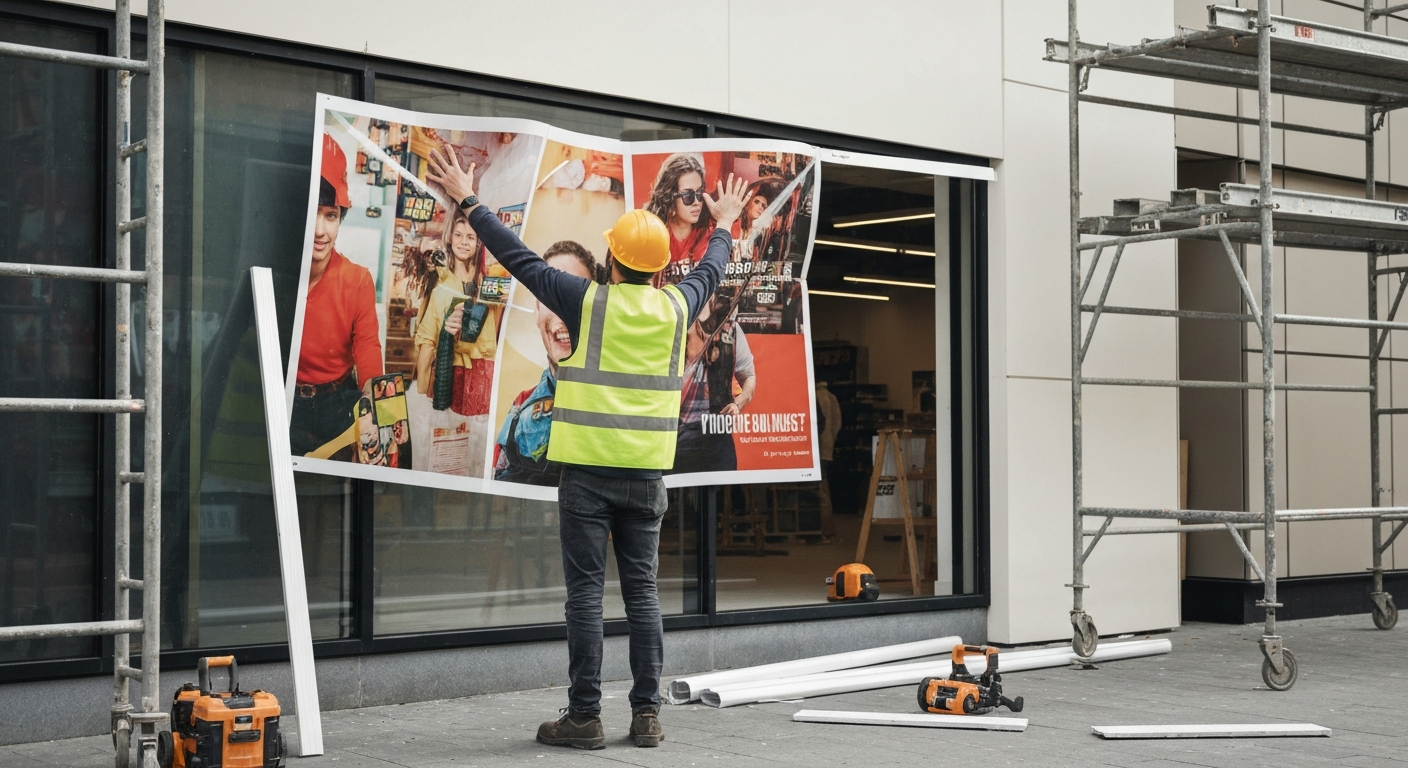
The lease is signed, the fit-out is underway, and the hoarding graphics are supposedly en route. Then install day arrives and something is wrong. A panel is 4 inches too short. The artwork references a campaign that was cancelled. Mall operations won't allow installation because the files were never pre-approved.
These aren't edge cases. They happen regularly, and always at the worst possible moment — when your construction timeline is already tight and every delay has a direct cost.
Here's what goes wrong during hoarding graphics installation, why it happens, and what a proper process looks like to prevent it.
Why Install Day Is the Worst Time to Discover a Problem
By the time your installer arrives on-site, you've already invested time in artwork approvals, print production, and logistics. A problem at that stage doesn't just cost money to fix — it costs time you don't have.
Mall access windows are narrow. Installers work outside of trading hours — often between midnight and 6 a.m. — because operations require it. If the graphics are wrong and the job can't be completed, that window closes. You're looking at a minimum of 48 to 72 hours before you can reschedule access, and that's assuming corrected panels can be reprinted and delivered in time.
Meanwhile, the hoarding wall sits bare, or worse, partially installed. That's what shoppers see.
The Most Common Ways Hoarding Graphics Fail on Arrival
Panels That Don't Fit the Wall
This is the most frequent problem, and it's entirely preventable. Hoarding walls in Canadian shopping centres are rarely standard dimensions. A wall at Cadillac Fairview Rideau Centre is not the same as one at Ivanhoé Cambridge's Quartier DIX30. Panel systems vary. Columns interrupt runs. Existing fixtures create offsets that don't appear on a leasing plan.
When a vendor produces panels from a floor plan drawing rather than actual on-site measurements, the numbers are often close — but close doesn't work in print. A 50mm gap between panels is visible from 20 feet away. A panel that overhangs a column can't be installed at all.
Artwork That Doesn't Match the Substrate
Some hoarding walls use painted plywood panel systems. Others use smooth-faced panels that accept vinyl directly. The substrate determines how the graphic is produced — the finish, the adhesive type, the print method.
If your vendor produces a vinyl wrap intended for a smooth surface and the wall is textured plywood, the graphic won't adhere cleanly. Bubbling and peeling start within days. That means a reprint, another install booking, and another access request.
Missing or Incomplete Panel Sets
Large hoarding runs are produced in sections. If one panel is missing from the shipment — damaged in transit, left off the production order, or simply overlooked — the installer can't complete the job. A partial installation looks worse than no installation at all, particularly on a high-visibility wall in a main concourse.
Graphics That Fail Mall Approval on the Spot
Landlords including Oxford Properties and Cadillac Fairview have specific requirements for hoarding graphics: approved colour palettes, minimum text sizes, content restrictions, and in some cases pre-approval of final artwork before installation begins. The property-by-property landlord requirements guide breaks down what each major landlord expects. If your vendor doesn't know these requirements — or doesn't build approval time into the schedule — the installer may arrive to find the job is blocked.
The mall won't accommodate it. The graphics come down, or they never go up.
What Actually Happens When the Graphics Are Wrong
The immediate consequence is a bare or incomplete hoarding wall. That's a brand problem — a coming soon space with no messaging tells shoppers nothing and signals a disorganized opening.
The downstream consequences are often worse. You need to:
- Reprint the affected panels, which takes a minimum of 2 to 4 business days
- Rebook mall access, which requires 48 to 72 hours' notice to operations and security
- Coordinate a second installer visit, with associated labour costs
- Potentially push your opening date if the construction schedule was already tight
If the error involves artwork — wrong campaign, outdated logo, incorrect store name — you're also working through a brand approval cycle before anything goes back to print. That adds another 1 to 3 business days depending on how quickly your internal team can turn around revised files.
The full financial picture of a failed hoarding installation is covered in more detail in The Hidden Costs of Getting Hoarding Graphics Wrong.
The Root Cause: Skipping or Rushing the Site Survey
Most install-day failures trace back to one decision made weeks earlier: using drawings instead of measurements, or skipping the on-site survey entirely.
A floor plan gives you approximate dimensions. It doesn't tell you about the column sitting 300mm inside the hoarding run, the electrical panel access door that needs to stay clear, or the slight bow in the wall that affects how panels sit. Only an on-site visit captures those details.
Vendors who skip this step do it to save time or cost on their end. The savings show up as problems on yours. A proper site survey adds one business day to the front of the project. A failed installation adds far more to the back.
For a detailed breakdown of what a site survey should cover, see Hoarding Graphics Site Survey: What It Covers.
How a Proper Production Process Prevents This
The process that prevents install-day failures isn't complicated. It requires discipline at each stage.
Brief and survey first. Before any artwork is produced, the wall needs to be measured on-site. Rapid Retail Graphics collects site photos and measurements the same or next business day after a project brief is received. Those measurements drive the panel layout — not the other way around.
Build the artwork to the actual wall. Once measurements are confirmed, artwork templates are created for the specific dimensions of that hoarding run. Your brand files are adapted to fit the layout, not scaled generically and hoped for the best.
Confirm mall requirements before production. Every mall has its own standards. Knowing those requirements before files go to print means the artwork that arrives on-site is the artwork that gets approved. This matters especially for properties managed by Ivanhoé Cambridge and Oxford, both of which have detailed hoarding graphic standards.
Coordinate access before the installer loads the van. Mall operations and security need advance notice. Booking the access window before panels are printed — not after — means the schedule is confirmed when production completes. The install coordination guide for mall security and operations walks through what that looks like in practice.
Photo proof on completion. A timestamped photo record confirms what was installed, where, and in what condition. If there's a dispute later, you have documentation.
What to Do If You're Already in a Crisis
If something has already gone wrong, the priority is accurate diagnosis before action.
First, confirm exactly what the problem is. A sizing issue requires a reprint. A missing panel may be in a second shipment. A mall approval hold may be resolvable with a revised artwork file rather than a full reprint. Don't order a full reprint until you know which panels are affected and why.
Second, contact mall operations immediately to understand your options for rebooking access. The sooner you're in their queue, the sooner you get a new window.
Third, if you need a vendor who can turn corrected panels around quickly, Rapid Retail Graphics offers rush options depending on location and project size. The average lead time from final artwork approval to installation is 1 to 5 business days, with faster turnaround available when the situation requires it. Reach the team at (604) 220-7700 or get an instant estimate.
For a broader look at the mistakes that lead to these situations, 5 Mistakes Retailers Make with Hoarding Graphics During Fit-Outs is worth reading before your next project.
FAQs
The Real Cost of Getting It Wrong
A failed hoarding installation isn't just an inconvenience. It's a bare wall on a high-traffic concourse, a delayed opening, a strained relationship with mall operations, and a reprint bill you didn't budget for.
Every one of those outcomes is avoidable with the right process at the front end. The site survey, the artwork-to-wall workflow, the mall approval step, the access coordination — none of it is complicated. It just has to happen in the right order, with a vendor who knows what they're doing.
If your next project is coming up, request a quote or call (604) 220-7700.
Have a hoarding project coming up?
Get a Quote