2026-05-04
5 Reasons Your Hoarding Graphics Vendor Is Slowing Down Your Store Opening
By David Chen — Leasing Coordination Advisor
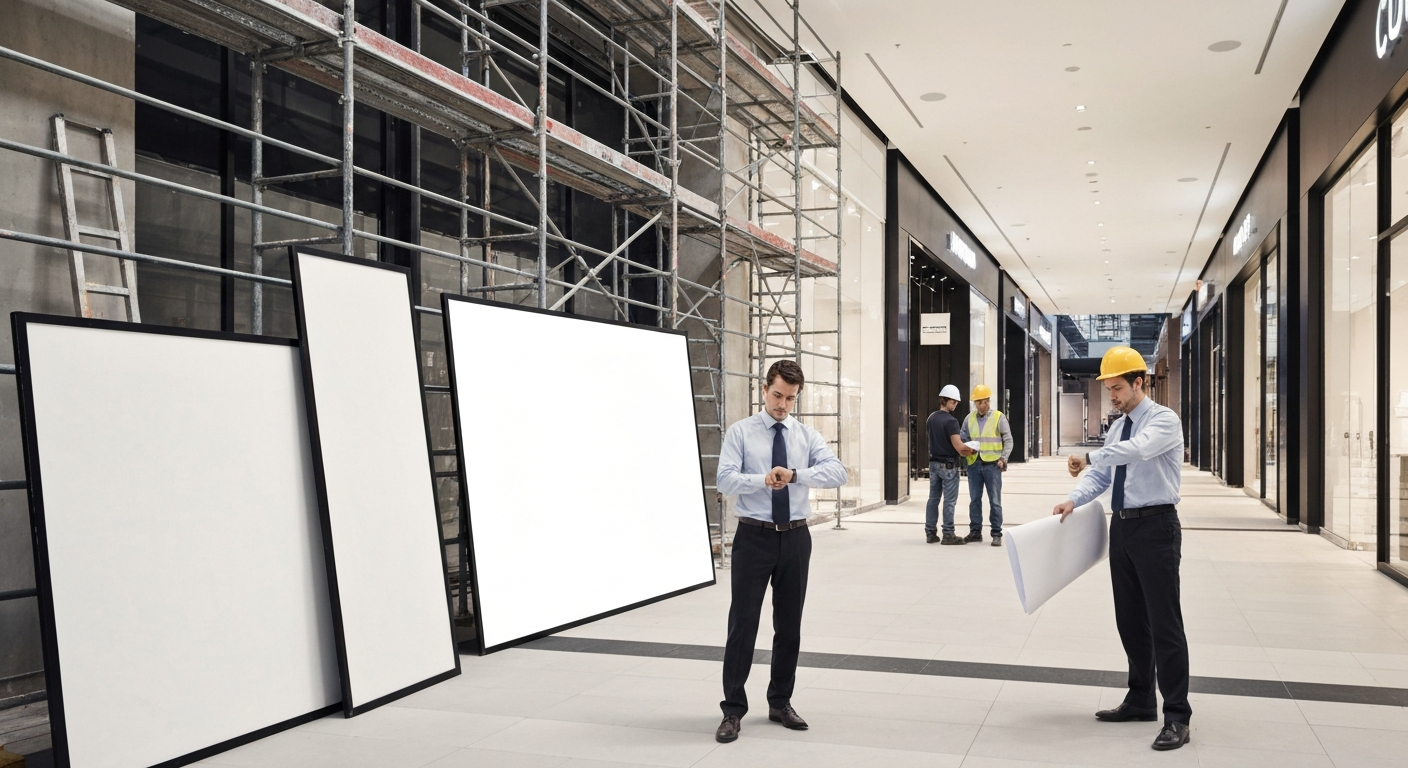
The lease is signed, the fit-out is underway, and the construction hoarding is up. Now you need retail marketing graphics on that wall before shoppers start walking past bare plywood.
Most vendors look capable until the job is actually running. That's when the gaps show up — wrong measurements, missed mall access windows, artwork that doesn't match the substrate. Each gap costs you time you don't have.
Here are the five most common ways a hoarding graphics vendor delays a store opening, and what to look for instead.
Reason 1: They Don't Do Site Surveys Before Quoting
A vendor who quotes from a floor plan or a rough measurement you've provided is already setting up a problem. Hoarding panels are rarely perfectly uniform. Panel seams, column intrusions, door cutouts, and fire exit clearances all affect how artwork gets laid out and printed.
When the graphics arrive on-site and the dimensions are off, you have two options: install something that looks wrong, or wait for a reprint. Neither works the week before opening.
A proper site survey — in person or through a structured photo and measurement request — eliminates this entirely. It's not an extra step. It's the step that makes everything else work. The full breakdown of what a site survey actually covers is worth reading before you accept a quote without one.
If a vendor skips it to move faster, they're borrowing time from you, not saving it.
Reason 2: They Can't Navigate Mall Access Requirements
Construction hoarding lives inside a mall. That means every install, refresh, and removal happens on the landlord's schedule, under the landlord's rules.
Major Canadian landlords — Cadillac Fairview, Oxford Properties, Ivanhoé Cambridge — each run their own contractor access protocols. Most require a formal access request 48 to 72 hours in advance. Many restrict installation to outside trading hours, meaning early mornings or overnight windows. Some require proof of insurance and a specific certificate of liability before any crew sets foot on the property.
A vendor unfamiliar with these requirements will either miss the access window or trigger a compliance issue that forces a redo. Either way, the hoarding goes up late.
The right vendor has worked at your specific mall before, or knows how to get the information fast. For more on coordinating this process, the article on coordinating hoarding graphics installs with mall security and operations covers the specifics — and the property-by-property landlord requirements guide breaks down what each major landlord actually expects.
Reason 3: Their Artwork Process Creates Revision Loops
This is where most delays actually originate. The vendor sends a proof. Your brand team flags an issue. You send corrections. A revised proof comes back. Your brand team flags something else. Three rounds later, you're five days behind and the print queue hasn't started.
The problem is usually one of two things: the vendor built the artwork template from the wrong dimensions — back to Reason 1 — or they don't have a clear process for adapting your existing brand files to the hoarding layout.
Your retail marketing graphics should start from your approved campaign creative, not from a blank template. A vendor who knows how to map your existing assets to a specific panel configuration cuts the revision cycle significantly. One round of proofing for final sign-off is realistic. Four rounds is a process failure.
If your artwork keeps coming back with issues, the article on 5 mistakes retailers make with hoarding graphics fit-outs outlines the most common file and briefing problems worth reviewing before your next project.
Reason 4: They Subcontract the Install to Someone Else
A vendor who prints in-house but outsources installation to a third party introduces a coordination gap. The print vendor doesn't own the install schedule. The installer doesn't own the artwork. When something goes wrong on-site — a panel that doesn't fit, a graphic that arrived damaged, a last-minute change from mall operations — there's no single person accountable for resolving it.
You end up managing the relationship between two vendors while your opening date moves.
This is where full-service delivery matters. When the same team handles site survey, print production, and installation, they own the outcome. If a panel needs to be reprinted the morning of the install, they know immediately and can respond. If mall operations shifts the access window, the installer is already in the loop. The full-service vs print-only comparison covers the practical difference.
Rapid Retail Graphics handles all three stages — survey, print, and install — so your team isn't chasing two separate vendors when the timeline tightens.
Reason 5: They Treat Every Job as a One-Off
A vendor with no institutional memory of your project, your brand standards, or your mall's requirements starts from zero every time. For a single one-location job, that's manageable. For a refresh cycle or a multi-location rollout, it's a real problem.
If your graphics are going stale and you need a refresh before a key retail period, a vendor who has to re-learn your brand files and re-survey the site adds unnecessary lead time. The seasonal retail refresh guide outlines when and how to plan these updates so they don't catch you off guard.
For retail chains managing multiple locations at once, the coordination challenge compounds. A vendor without a structured process for multi-location work treats each site as a separate job — separate timelines, separate artwork reviews, separate install schedules. The article on multi-location hoarding graphics for Canadian retail chains addresses this directly.
What a Vendor That Doesn't Slow You Down Looks Like
The pattern across all five reasons is the same: delays come from vendors who handle only part of the job, or who lack the specific experience that mall retail requires.
A vendor worth working with on a tight opening timeline will:
- Conduct a site survey or structured measurement request before production starts
- Know the access protocols at your specific mall property
- Build artwork from your existing brand files, not a generic template
- Own the install rather than hand it off to an unconnected crew
- Retain your project details for future refreshes and multi-location work
The 1 to 5 business day turnaround that's realistic for a well-run project only holds when none of these gaps exist. One missing step pushes that window out — and in retail, a week's delay before opening is not a minor inconvenience.
If you're evaluating vendors and want to understand where hidden costs typically appear, the article on the hidden costs of hoarding graphics done wrong is worth reading before you commit.
FAQs
Ready to brief a vendor that won't slow you down? Get an instant estimate or request a detailed quote — or call (604) 220-7700 to talk through your opening date.
Have a hoarding project coming up?
Get a Quote