2026-05-04
How Fast Can Hoarding Graphics Actually Be Installed? A Realistic Timeline Breakdown
By Mike Torres — Senior Install Coordinator, 12+ Years in Retail Fit-Out
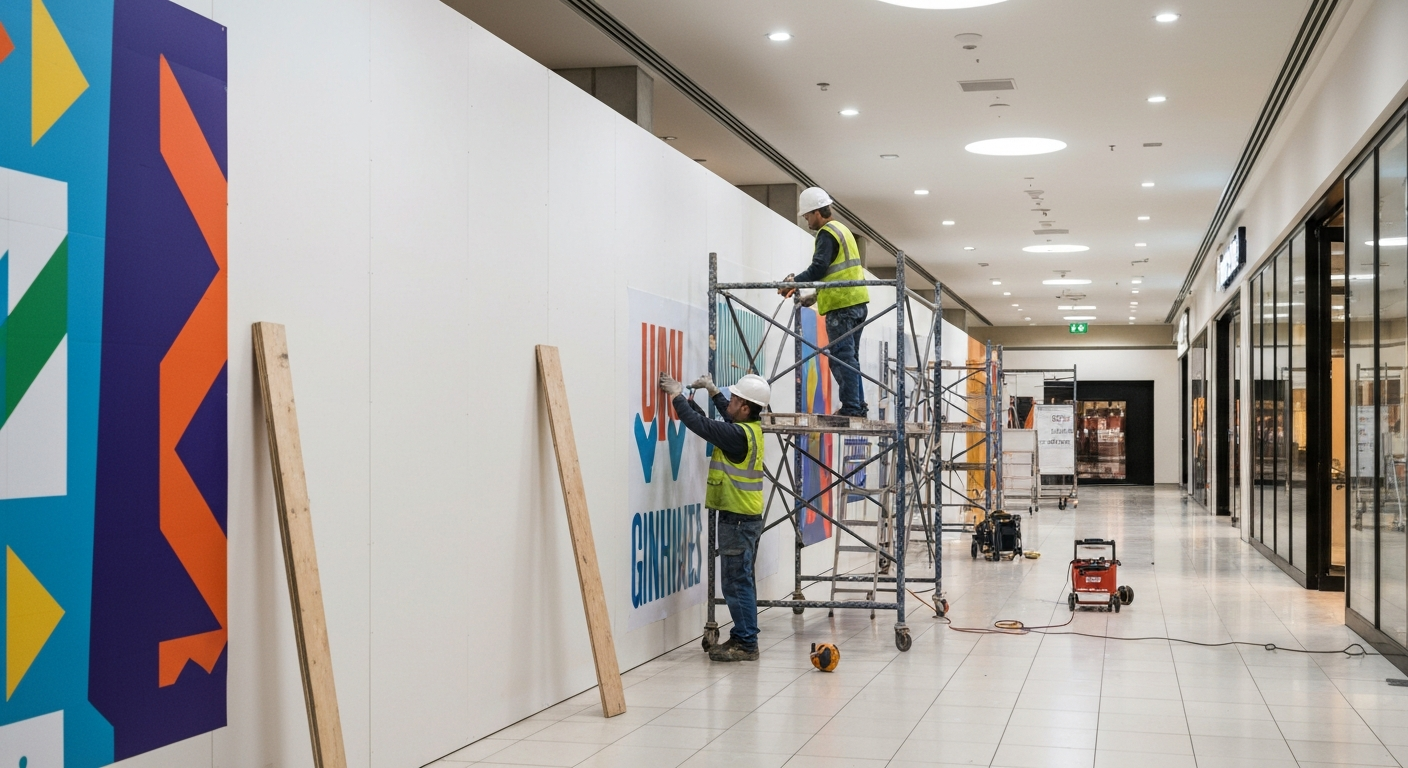
You've got a lease date locked in, construction is underway, and someone just asked when the hoarding graphics will be ready. You need a real answer — not a vague estimate that falls apart the moment a proof comes back wrong or mall operations pushes back on access.
When the process runs cleanly, a full hoarding graphics installation — from first brief to completed install — takes 1 to 5 business days. But "runs cleanly" depends on specific conditions that are worth understanding before you commit to a date.
Here's a breakdown of every stage, where time actually gets lost, and what a realistic rush looks like.
What "Fast" Actually Means in a Mall Context
Hoarding graphics aren't window decals. A typical hoarding wall in a Canadian mall runs anywhere from 20 to 80 linear feet, often with panel seams, door cutouts, and landlord-specific substrate requirements. Cadillac Fairview, Oxford Properties, and Ivanhoé Cambridge each have their own approval processes and access protocols.
Speed in this context means compressing each stage without skipping any of them. A vendor who quotes you a 24-hour turnaround without asking about site access or landlord specs is telling you what you want to hear — not what's actually possible.
For the property-by-property breakdown, this guide on what CF, Oxford, and Ivanhoé Cambridge actually require covers the submission specs and approval timelines in detail.
The Full Timeline, Stage by Stage
Stage 1: Site Survey and Measurements
Before anything gets printed, someone needs to physically measure the hoarding wall. Dimensions from a lease drawing are rarely sufficient — panel widths shift, door frames add complexity, and existing substrate conditions affect how graphics are applied.
A same-day or next-day site visit is achievable for most projects in major Canadian markets. The output is an accurate measurement set and site photos that feed directly into the artwork template.
Skipping this step is one of the most common causes of reprints. If your graphics arrive and the panels don't align with the actual wall, you're reprinting and rebooking access — a 1 to 5 business day setback, minimum.
The hoarding graphics site survey guide covers exactly what a proper survey should capture.
Time required: same day or next business day.
Stage 2: Artwork and Approvals
This is where most timelines slip. If you have print-ready brand files, the artwork stage moves quickly — templates get applied, panels get laid out, and a proof goes back to you within 24 hours.
If artwork needs to be adapted from campaign creative, or if the brand team needs to review before anything goes to print, build in an extra day or two. Approval chains involving multiple stakeholders — especially across a retail brand's internal marketing team and a landlord's design standards team — can add 2 to 3 business days on their own.
The practical fix: get artwork moving the same day you confirm the lease. Don't wait for construction milestones to start the graphics process.
Time required: 1 to 3 business days, depending on artwork readiness and approval chain.
Stage 3: Print Production
Once artwork is approved and files are print-ready, production on a standard hoarding project typically runs 1 to 2 business days. Large-format printing at this scale uses durable substrates with matte laminate or cleanable finishes suited to high-traffic mall environments.
Rush production is possible in some cases, but it depends on current shop capacity and total square footage. A 200-square-foot hoarding is a different conversation than an 800-square-foot wrap.
Time required: 1 to 2 business days.
Stage 4: Mall Access Coordination
This stage catches people off guard if they haven't done a mall installation before. Most major Canadian shopping centres require a formal contractor access request submitted at least 48 to 72 hours in advance. Some properties also require insurance certificates, a list of installers, and equipment declarations before they'll issue an access permit.
Installations are typically scheduled outside of trading hours — early mornings, evenings, or overnight — which limits available windows per week. Miss the access window for a given night, and you're waiting for the next available slot.
This isn't a stage you can compress by calling in a favour. Mall operations runs on its own schedule, and that process needs to be built into your timeline from day one. The mall security and operations coordination guide outlines exactly what that process involves.
Time required: 48 to 72 hours minimum, often longer if access slots are limited.
Stage 5: Installation
The physical installation of hoarding graphics in a mall typically takes 4 to 8 hours for a standard single-tenant hoarding wall, depending on size, panel count, and complexity. Installers work during the approved access window, and photo proof of completion is provided once the job is done.
Time required: 4 to 8 hours on-site.
Where Projects Actually Lose Time
Most delays don't happen in print production. They happen in the stages on either side of it.
The most common causes of timeline overruns:
- Artwork that isn't print-ready. RGB files, missing bleed, low-resolution imagery — any of these send the project back to the brand team before production can start.
- Approval chains that weren't mapped out in advance. If three people need to sign off on a proof and two are in different time zones, a 24-hour approval window becomes 48 or 72 hours.
- Landlord access requests submitted late. Submitting your contractor access request the day before you need to install isn't a plan — it's a gamble.
- Site dimensions sourced from drawings rather than a physical survey. Panels that don't align on-site mean a reprint, and a reprint means starting the production clock over.
- Underestimating the cost of getting it wrong. The hidden costs of hoarding graphics errors are worth reviewing before you finalize your vendor and timeline.
What a Rush Timeline Looks Like
When a lease date is imminent and the standard process isn't an option, a compressed timeline is possible — but it requires every stage to move in parallel rather than sequentially.
A realistic rush scenario looks like this:
- Site survey happens the same day as the brief
- Artwork is adapted from existing brand files, not created from scratch
- Approval is limited to one decision-maker with a 4-hour review window
- Print runs overnight or on priority queue
- The mall access request was already submitted — or the landlord contact is reachable to expedite
Under those conditions, 48 hours from brief to install is achievable. It's not the norm, and it requires cooperation from every party in the chain. But it's not fiction either.
What doesn't work: assuming a rush is possible without confirming mall access availability first. If the only installation window is 72 hours out, the print turnaround is irrelevant.
What You Can Do to Protect Your Timeline
The single most effective thing you can do is start the hoarding graphics process earlier than feels necessary.
A few practical steps:
- Brief your graphics vendor the same week you confirm the lease. Don't wait for construction to reach a certain stage.
- Identify your approval chain before artwork goes out for review. Know who needs to sign off and set a hard deadline for feedback.
- Confirm mall access requirements with operations before submitting your contractor request. Requirements vary by property and can include insurance certificates, equipment lists, and named installers.
- Use a vendor who handles site surveys directly. Coordinating between a print shop and a separate installer adds handoff points — and that's where things go wrong.
For teams managing multiple locations across Canada, the coordination complexity multiplies. The multi-location hoarding graphics guide covers how to keep parallel projects from colliding.
Rapid Retail Graphics handles the full process — survey, artwork, print, and installation — so your team isn't chasing three separate vendors to hit one deadline. If you're working against a tight opening date, the leasing coordinator's guide to hoarding graphics is a useful reference for what to expect at each stage.
FAQs
The Bottom Line
A 1 to 5 business day timeline is realistic. A 48-hour rush is possible. A last-minute scramble that skips the site survey or submits a mall access request the day before install is a risk that almost always costs more than the time it was meant to save.
Start early, get the survey done, and confirm mall access before you lock in your production schedule. When those pieces are in place, the rest of the process moves quickly.
Ready to lock in a real timeline? Get an instant estimate or request a detailed quote — or call (604) 220-7700 to talk through the schedule before you commit to a date.
Have a hoarding project coming up?
Get a Quote