2026-10-01
Fast Turnaround Hoarding Graphics: What 1-5 Days Actually Means
By Bryce Mitchell — Founder, Rapid Retail Graphics
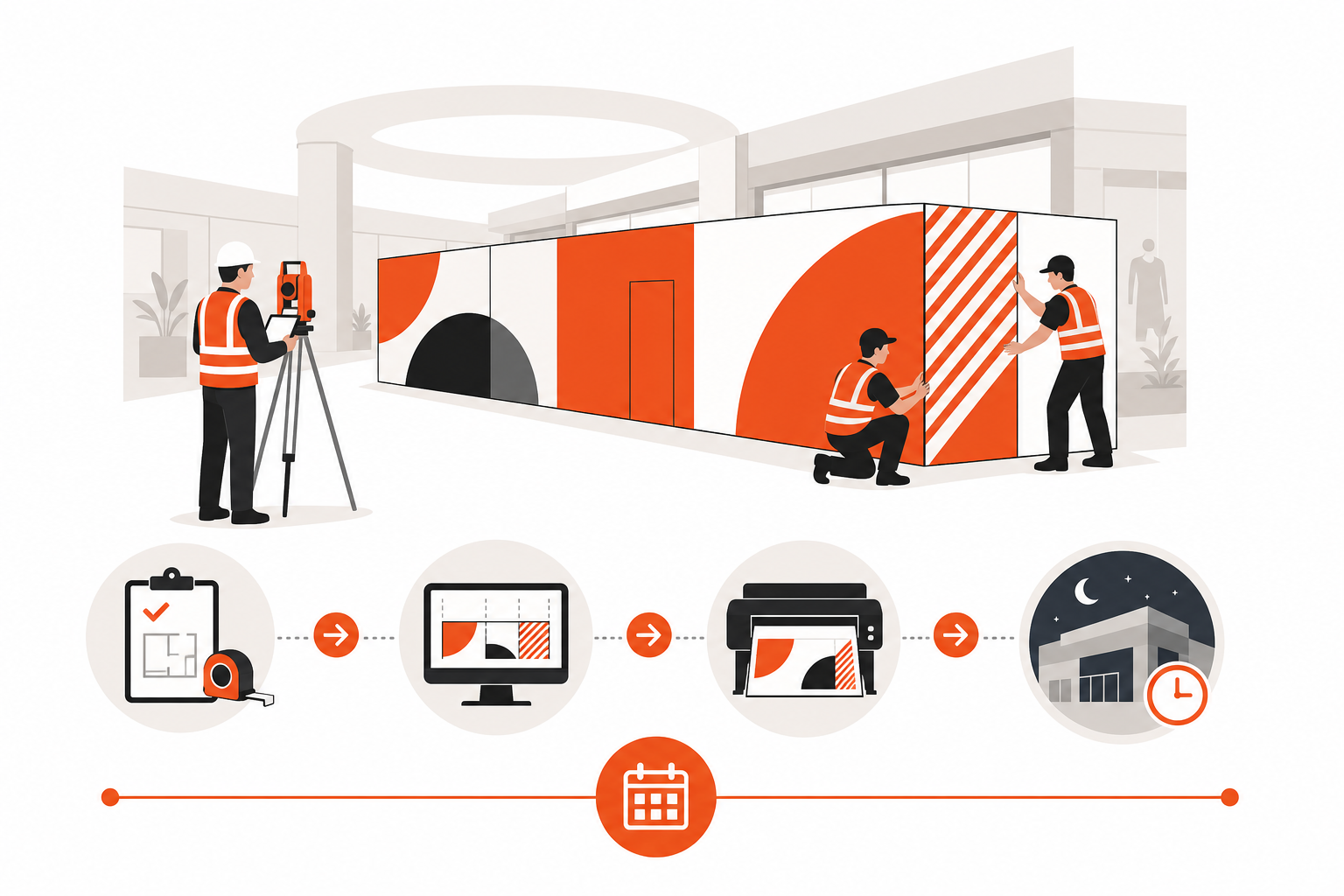
Fast turnaround hoarding graphics means 1 to 5 business days from site survey to installed panels. You have a lease signed, a fit-out clock running, and a store opening date that does not move. The hoarding needs to go up before construction starts, and this is exactly how long that takes. Understanding each stage inside that window, survey, artwork, print, coordination, and install, is what makes the timeline reliable.
What Does 'Fast Turnaround' Actually Mean for Hoarding Graphics?
Fast turnaround for hoarding graphics means the full process, from the moment a vendor has confirmed site dimensions and approved artwork through to panels physically installed on-site, completed within 1 to 5 business days. That definition matters because most vendors quote turnaround from artwork approval only, not from the start of the project.
There are two distinct clocks in any hoarding project. The first runs from brief to artwork approval: gathering site dimensions, producing artwork templates, and getting sign-off from your brand team. The second runs from artwork approval to installed panels: print production, mall operations coordination, and the physical install. Vendors who quote a turnaround number are almost always quoting the second clock. The first one is yours to manage.
The industry-wide standard lead time from artwork approval to installed hoarding is 5–10 working days. Expedited services at some providers can bring that down to around 3 working days for standard panels. A full-service vendor who controls survey, artwork, print, and installation under one roof can compress the combined window further, because there are no handoffs between separate companies adding lag at each stage.
Knowing which clock a vendor is quoting is the first question to ask. A number that sounds fast may only cover half the process. For a detailed look at how hoarding printing turnaround times break down within the print production stage specifically, that article covers the print side in depth.
The Full Process: From Site Survey to Overnight Installation
A full-service hoarding graphics delivery follows four stages in sequence. Time gets consumed differently at each one, and knowing where the risk sits helps you protect the schedule.
Step 1: Site Survey and Measurements
Before any artwork gets produced, someone needs accurate panel dimensions. Panels that look uniform on a floor plan may vary by several inches in the field, and a column interruption or corner return that isn't captured in a drawing will show up as a misaligned graphic after installation.
A site survey captures precise photos and measurements of the hoarding perimeter. For a single-vendor operation, those measurements feed directly into artwork template production with no handoff to a third party. That matters for speed. Every handoff between separate companies adds a waiting period that doesn't show up in any individual vendor's quoted turnaround.
Final pricing is confirmed after site photo and drawing review, not before, because the field conditions determine the actual scope.
Step 2: Artwork Template Production
Once dimensions are confirmed, campaign creative gets adapted into artwork templates that align with the specific site elevations and fixing positions of the hoarding. This is not resizing. It involves fitting brand assets to actual panel breaks, accounting for seams, column interruptions, and corner returns so the finished graphic reads correctly at full scale.
Clean source files with correct color profiles and high-resolution assets cut 1–2 days off artwork production. If artwork needs to be produced from a brief, that work happens here. Either way, this stage ends when you have a proof ready for approval.
Step 3: Print Production
Finalized artwork goes to production once approval is confirmed. Large-format hoarding graphics require time on press, finishing, and preparation for installation. The substrate choice affects this stage, and material options are covered in the next section.
Volume is the biggest variable here. A single-location job moves through production faster than a multi-panel program across several stores. If you're running a rollout across multiple locations, confirm whether your vendor runs concurrent production or queues jobs sequentially. That distinction can add days to a program that looks straightforward on paper.
Step 4: Coordinated Overnight Installation
Installation is typically scheduled outside trading hours to avoid disrupting shoppers and site operations. That means available install windows are narrower than a standard workday, and the next available after-hours slot may be one or two nights out from when print is ready.
Mall operations teams at landlords including Cadillac Fairview, Oxford Properties, Ivanhoe Cambridge, and Simon all have their own requirements for contractor access and scheduling. A vendor who coordinates directly with mall ops as part of their standard process removes that coordination load from your plate. A vendor who quotes print delivery but leaves installation scheduling to you is handing you a job that can easily consume several days on its own. Rapid Retail Graphics is a full-service hoarding graphics provider that handles survey, artwork, print, and installation under one roof, including direct coordination with mall operations teams.
Some specialist providers aim to complete installation within 24 hours of the hoarding structure being erected. That kind of speed depends on access being pre-confirmed and artwork being ready to go.
The full 6-stage install timeline covers each of these stages in detail, including what documentation each stage requires and where approval bottlenecks most commonly appear.
Material Options: ACM, Foamex, Vinyl, and Mesh Compared
The substrate you choose affects durability, production time, and how the hoarding comes down at the end of the project. These are the four materials most commonly used for hoarding graphics.
| Material | Typical Use | Weather Resistant | Graffiti Resistant | Removal Complexity |
|---|---|---|---|---|
| ACM (aluminium composite) | Long-duration exterior hoardings, high-traffic locations | High | High | Moderate, panels are mechanically fixed |
| Foamex (PVC foam board) | Interior hoardings, shorter-duration installs | Moderate | Moderate | Low, lightweight panels lift off cleanly |
| Vinyl (self-adhesive or banner) | Applied over existing hoarding structures, short campaigns | Moderate | Low to moderate | Low, peels or rolls off |
| Mesh (perforated vinyl) | Scaffolding wraps, large-span coverage, wind-load environments | High | Low | Low, rolls up and removes quickly |
Vinyl is worth noting for cost-sensitive programs. Vinyl hoarding graphics typically cost 60–70% less than painted alternatives while offering quicker turnaround and easier removal. For a short-duration campaign where the hoarding will come down in weeks rather than months, vinyl applied over an existing structure is often the most practical choice.
For longer-duration projects, ACM and Foamex provide more durable finished surfaces that hold up to foot traffic and environmental exposure. Construction hoarding at major redevelopment sites is sometimes intended to remain in place for up to two years, which is why material selection needs to match project duration, not just budget.
Mesh is the right choice when the hoarding spans a scaffolding structure rather than a solid panel frame. Wind load is the governing factor on large exterior wraps, and mesh's perforated structure reduces it significantly compared to solid vinyl.
How Is Hoarding Graphics Pricing Structured?
Hoarding graphics pricing in the industry is typically structured on a per-square-foot basis, covering print and installation as a combined scope rather than billing each separately. That model makes budgeting straightforward: you know the linear footage of your hoarding, you apply a rate, and you have a working number before the project starts.
Final pricing depends on site conditions. Panel configuration, substrate choice, access requirements, and installation complexity all affect the actual cost. That's why quotes are confirmed after a site photo and drawing review, not before. A number given before site review is an estimate; the confirmed figure comes once the vendor has seen the field conditions.
Material choice is the biggest lever on cost within a given project. Vinyl applied over an existing structure costs less than ACM panels fabricated for a new hoarding frame. Shorter-duration campaigns benefit from vinyl's cost advantage. Longer-duration installs, where durability and finish quality matter more, typically use ACM or Foamex, which carry a higher per-square-foot cost.
For a full breakdown of how project size, material, and timeline interact with cost, the retail hoarding graphics cost and timeline guide covers the pricing structure in detail, including what variables move the number up or down. The pricing and turnaround overview for 2026 sets out current rates and lead times across material types.
Legal and Safety Compliance: CSCS, CDM, and Permits
Compliance requirements affect your installation schedule, and missing documentation is one of the most common reasons an install date moves at the last minute.
On the worker certification side, installation crews are expected to carry recognized skills credentials for on-site construction work. In the UK, that means CSCS cards. In North America, equivalent site safety certifications and contractor credentials apply depending on the jurisdiction and the specific mall landlord's requirements. Confirming that your vendor's installation team meets the landlord's contractor standards before the install date is scheduled is worth doing early, not the night before.
CDM (Construction Design and Management) regulations govern how construction projects are planned and managed for worker safety. While CDM is a UK framework, the underlying principle, that someone is responsible for coordinating safety across all contractors on a construction site, applies broadly. In a North American mall context, that coordination typically runs through the general contractor or the mall's own construction management team. Your hoarding vendor needs to fit within that structure, not outside it.
Local authority permits are a separate layer. A permit for the physical hoarding structure is distinct from any internal mall approval. The two processes run in parallel, and both need to be complete before installation day.
Advertisement consent is a further distinction worth understanding. A standard construction permit covers the physical hoarding structure. If the hoarding carries branded graphics rather than plain panels, some authorities require a separate advertisement consent application. Requirements vary by municipality. Confirming which category your hoarding falls into with the relevant authority, or with a vendor who has navigated that process in your market, avoids a compliance hold that can delay an otherwise ready install.
What Compresses or Expands the Hoarding Graphics Timeline?
Some variables are yours to control. Others sit with the landlord or the production queue. Knowing which is which lets you protect the schedule where you can and build buffer where you can't.
| Variable | Effect on Timeline | Who Controls It |
|---|---|---|
| Clean, print-ready source files | Compresses artwork stage by 1-2 days | Client |
| Pre-confirmed after-hours access with mall ops | Removes scheduling lag at the install stage | Client + vendor |
| Verified site dimensions before engagement | Eliminates or shortens the survey stage | Client |
| Internal approval process with multiple stakeholders | Expands the artwork approval stage | Client |
| Artwork revision cycles | Each round adds time before print can start | Client |
| Landlord approval documentation missing | Pushes the install window until docs are submitted | Client + landlord |
| Multi-location program running concurrently | Adds coordination surface area at every stage | Vendor + client |
| Production queue at time of order | Affects print stage, varies by vendor capacity | Vendor |
The variables on the client side are the ones most often underestimated. Artwork approval is the clearest example. If your internal review process involves a brand manager, a leasing coordinator, and a regional director, and each reviews sequentially rather than simultaneously, three rounds of sign-off can consume more calendar time than the print production itself.
Landlord approval delays follow a similar pattern. Cadillac Fairview and Oxford Properties properties, in particular, tend to require detailed documentation packages before installation proceeds. A missing brand standards certificate or an unscaled drawing can hold an otherwise ready job for several days while the paperwork catches up.
On the vendor side, the biggest compressor is a single-vendor model that removes handoffs. Every transfer between a measurement company, a design studio, a print house, and a separate installation crew adds a waiting period that doesn't appear in any individual quote. A vendor who runs all four stages internally removes that lag by design.
How to Plan Your Hoarding Project Schedule Working Backward from Opening Day
Start from your store opening date and work backward. Most projects have less buffer than the leasing coordinator initially assumes, and the gaps usually appear at the approval and access stages, not in print production.
Here is the sequence in reverse order:
- Identify your latest possible install date. This is typically the day before construction hoarding is required to be in place. Everything else anchors to this date.
- Add the installation window. A single-location job usually takes one overnight session. A larger program may require two or three consecutive access windows.
- Add mall operations lead time. After-hours access windows are finite. If the next available slot is two nights out from when print is ready, that is two days added to your effective timeline regardless of how fast the vendor produced the graphics.
- Add print production time. Confirm this for your specific job size and substrate. A multi-panel program takes longer than a single-location run.
- Add artwork approval time. Be honest about how long your internal process actually takes. If three stakeholders review sequentially, that is rarely less than two business days.
- Add artwork production time. Faster with clean, print-ready source files. Slower if artwork needs to be built from a brief.
- Add site survey time if verified dimensions are not already in hand.
Work backward from step one and you have the latest date you can engage a vendor and still hit the deadline. If that date has already passed, ask about rush options at the quote stage.
Use the instant estimate calculator to get a starting number based on your square footage before committing time to a formal quote process.
FAQs
Conclusion
Fast turnaround hoarding graphics covers the full process from site survey to installed panels, not just the time a file spends on press. The 1-to-5-business-day window is real and achievable, but it depends on artwork being approved, site dimensions being confirmed, and mall operations access being locked in before the clock starts. The industry-wide standard from artwork approval to installation runs 5–10 working days, so the gap between a full-service vendor and a print-only vendor shows up directly in your project schedule.
Work backward from your opening date, build honest buffer into the artwork approval stage, and confirm at the quote stage whether your vendor's turnaround number includes installation or stops at print. If your timeline is already compressed, ask about rush options early.
Have a hoarding project coming up?
Get a Quote