2026-09-30
Construction Barrier Wrap Cost: What Drives the Final Number
By Bryce Mitchell — Founder, Rapid Retail Graphics
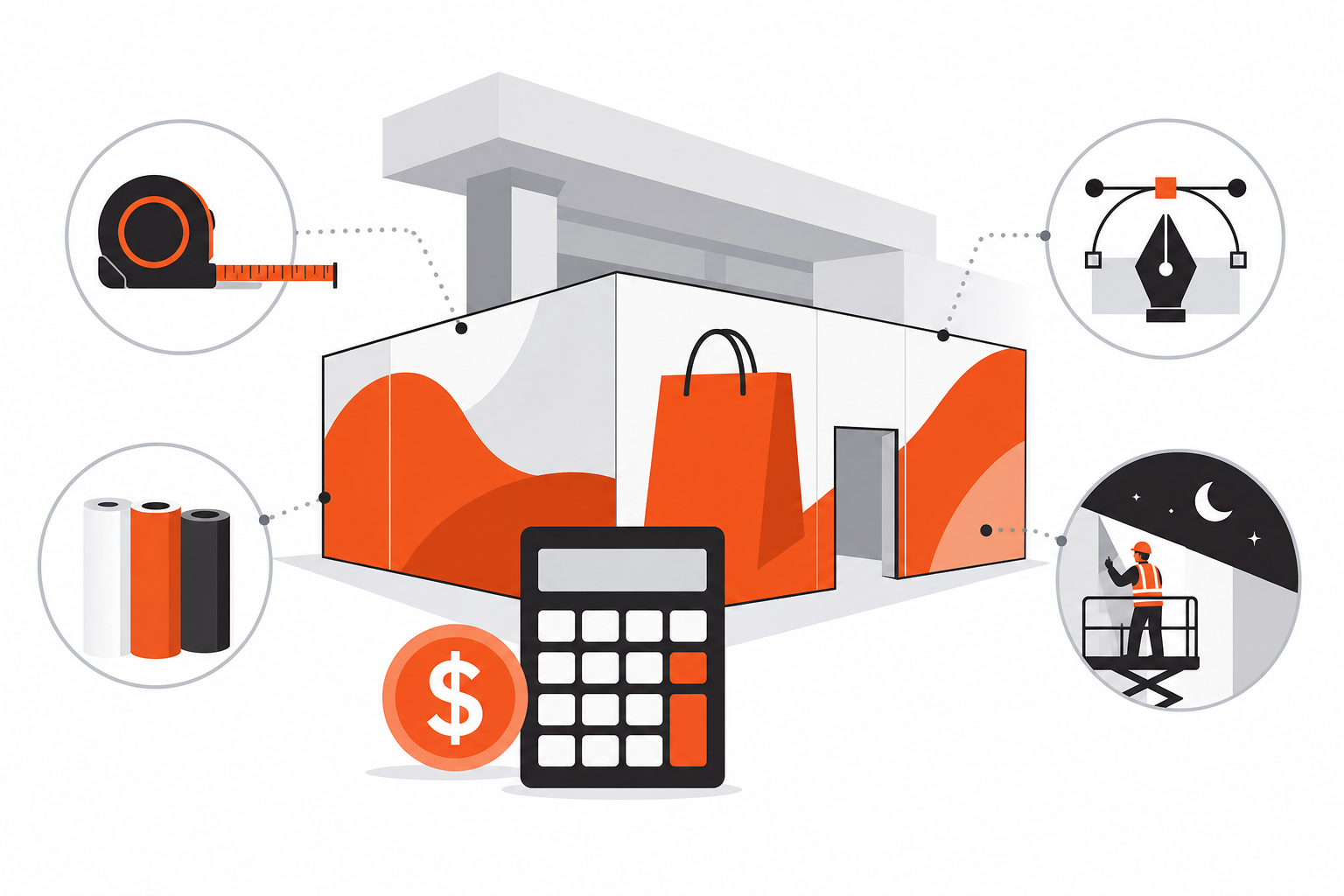
You have a lease signed, a fit-out clock running, and an opening date that does not move. The question of construction barrier wrap cost lands on your desk early — and the range you get back from vendors is wide enough to be useless. This article breaks down what actually drives the final number so you can budget accurately and avoid the surprises that show up on invoice day.
Why the Price Range Is So Wide
Ask three vendors for a quote and you will get three numbers that look like they are describing different products. Often, they are.
The variables that move the price most are linear footage, substrate choice, artwork complexity, installation timing, and whether you are buying print alone or a full-service program that includes survey, artwork adaptation, and coordinated installation. Each of those adds or subtracts cost independently. A square-footage rate without that context tells you almost nothing.
The Core Cost Driver: Square Footage and Linear Run
Every pricing model starts with area. The wider and taller the hoarding run, the more print substrate you need and the more installation time the crew requires.
A 20- to 30-linear-foot lease-line run at a standard mall height of 8 feet is a materially different job than a 120-foot perimeter wrap at 10 feet. Print cost scales roughly with area. Installation cost does not scale at the same rate — crew mobilization, equipment, and after-hours access fees are partially fixed regardless of how many panels go up.
That fixed-cost floor is why smaller jobs often feel expensive per square foot, and larger programs tend to come in lower on a per-unit basis.
Substrate and Print Specification
The material you print on is one of the biggest cost levers in the budget.
Budget-tier vinyl substrates meet minimum requirements for indoor mall environments and keep material cost low. Mid-tier products add durability, better adhesion to textured surfaces, and improved color fidelity. Premium substrates rated for longer-term or exterior installations carry meaningfully higher material costs.
For context on how wide material cost ranges can run in the construction wrap category: R-Value Associates noted in 2026 that mid-tier house wrap products like Tyvek HomeWrap typically cost between $0.12 and $0.16 per square foot for materials, while BuildMat Insight reported in 2026 that fluid-applied building wrap membranes can reach installed costs between $2.20 and $3.50 per square foot. Those are building envelope products, not printed graphics — but they illustrate how substrate specification alone can move a number by an order of magnitude.
For printed retail hoarding graphics, the substrate decision is usually driven by landlord specification requirements, not buyer preference. Simon, Cadillac Fairview, Oxford Properties, and Ivanhoe Cambridge each maintain hoarding standards that specify acceptable materials and finishes. If your landlord requires a specific substrate, that is your cost floor.
Artwork Complexity and Adaptation
Print-ready files handed off in the correct panel dimensions at the correct resolution cost less to produce than artwork that needs to be rebuilt.
If your brand team provides campaign creative sized for a billboard or a social format, it has to be adapted for hoarding panel layouts — accounting for panel joints, structural columns, fire exit signage placement, and any landlord-mandated clearance zones. The more complex the adaptation, the more production time, and the higher the artwork line item.
The inverse is also true. A single-color brand block with a logo and a copy line is fast to adapt and fast to proof. A full-bleed photographic campaign with fine detail near panel edges takes longer and requires more review cycles.
Installation: The Cost Most Buyers Underestimate
Installation is consistently the line item that surprises buyers who have only budgeted for print.
In mall environments, installation is almost always performed outside trading hours. That means evening or overnight crews, coordination with mall operations and security, and in some cases equipment like scissor lifts or scaffolding depending on ceiling height. Those logistics carry real costs that do not appear in a print-only quote.
Labor rates also vary by location. Major markets like New York, Los Angeles, Toronto, and Chicago carry higher crew rates than secondary markets. Freight and logistics to remote or non-metro locations add further cost, particularly for large-format substrate rolls.
BuildMat Insight reported in 2026 that installing traditional house wrap on a 2,500-square-foot single-story home adds between $440 and $780 in direct labor costs. Retail hoarding installation in a mall involves different access constraints and crew requirements, but the principle holds: labor is a material portion of the total, not a rounding error.
When comparing vendor quotes, confirm whether installation is included — and if so, whether after-hours access and coordination with mall operations is covered. A quote that excludes those items will look cheaper until it is not.
Single-Vendor vs. Multi-Vendor Coordination
How you structure the project has a direct effect on total cost, even when no single line item changes.
When print, artwork, and installation are split across separate vendors, someone has to manage the handoffs. That is typically you or your project coordinator. Files have to be transferred and approved between parties. Installation scheduling has to be confirmed independently. If one vendor misses a date, the others may not be able to flex — and the delay falls to you.
That coordination cost is real, even if it never appears on an invoice. Missed installation windows in mall environments often mean rebooking outside trading hours, which can add days to the schedule and push against a hard opening date.
A single-vendor model that covers survey, artwork adaptation, print, and after-hours installation under one program removes that overhead. It also creates one point of accountability. If the panels are wrong, there is no ambiguity about whose problem it is.
Rapid Retail Graphics operates on that model, handling the complete project lifecycle from site survey through installed graphics, with an average lead time of 1 to 5 business days. Pricing is approximately $6 per square foot, inclusive of print and standard installation, with final pricing confirmed after reviewing site photos and drawings. Projects typically range from $5,000 to $30,000 depending on scope. An instant estimate calculator is available if you want a working number before you have a formal quote.
Rush Timelines and Their Cost Implications
Standard lead times are priced into a standard quote. Rush timelines are not.
If your fit-out schedule slips and you need hoarding graphics installed faster than a standard program allows, expect a premium. Rush work requires pre-empting other scheduled jobs, expediting print production, and in some cases sourcing crew availability at short notice. Those costs get passed through.
The practical implication: lock in your hoarding vendor as early in the fit-out process as possible. The moment you have a lease handover date, you have enough information to start the conversation. Waiting until the week before opening is when rush premiums and missed windows become real risks.
What a Realistic Budget Looks Like
For a mid-size retail hoarding program in a North American mall, the variables that most affect where your project lands in the $5,000 to $30,000 range are:
- Linear footage and height of the hoarding run
- Substrate specification required by the landlord
- Artwork condition and how much adaptation is needed
- Market location and associated labor and logistics costs
- Timeline and whether rush production is required
A 60-linear-foot run at standard mall height in a primary market with print-ready artwork and a standard lead time lands in a very different place than a 200-linear-foot perimeter with a complex campaign adaptation requiring overnight crew access.
The fastest way to get a number that reflects your actual project is to provide site photos, drawings, and your installation date. That is when a quote stops being an estimate and starts being a commitment.
For multi-location programs, the coordination and logistics variables multiply. A multi-location rollout requires consistent artwork across all sites, staggered installation scheduling, and a vendor with the capacity to manage parallel programs without quality variation between locations.
After-Hours Installation and Mall Compliance
One cost that rarely appears as a line item but affects total project cost is the compliance overhead associated with mall installation.
Landlords require installation outside trading hours, coordination with mall operations and security, and in many cases specific insurance documentation, crew certification, and advance notice before any work begins. If your vendor does not handle that coordination, you do — and that has a time cost.
Knowing what your specific landlord requires before you brief a vendor means you can confirm upfront that the vendor's standard process covers it. For a detailed look at how after-hours installation works in practice, the guide on installing branded construction barriers in a mall without disrupting shoppers covers the operational specifics.
The Market Context
Demand in this category is growing. According to pmarketresearch.com's 2026 data, the barricade sheeting market is projected to grow at a CAGR of 6.8% from 2025 to 2032. More retail fit-outs, more renovation programs, and more landlords requiring compliant hoarding graphics means vendor capacity at the quality end of the market is not unlimited. That is a practical reason to book early — not just a scheduling preference.
FAQs
Have a hoarding project coming up?
Get a Quote