2026-05-19
How to Install Branded Construction Barriers in a Mall Without Disrupting Shoppers (2026 Guide)
By David Chen — Mall Operations Lead, 10+ Years in Retail Real Estate
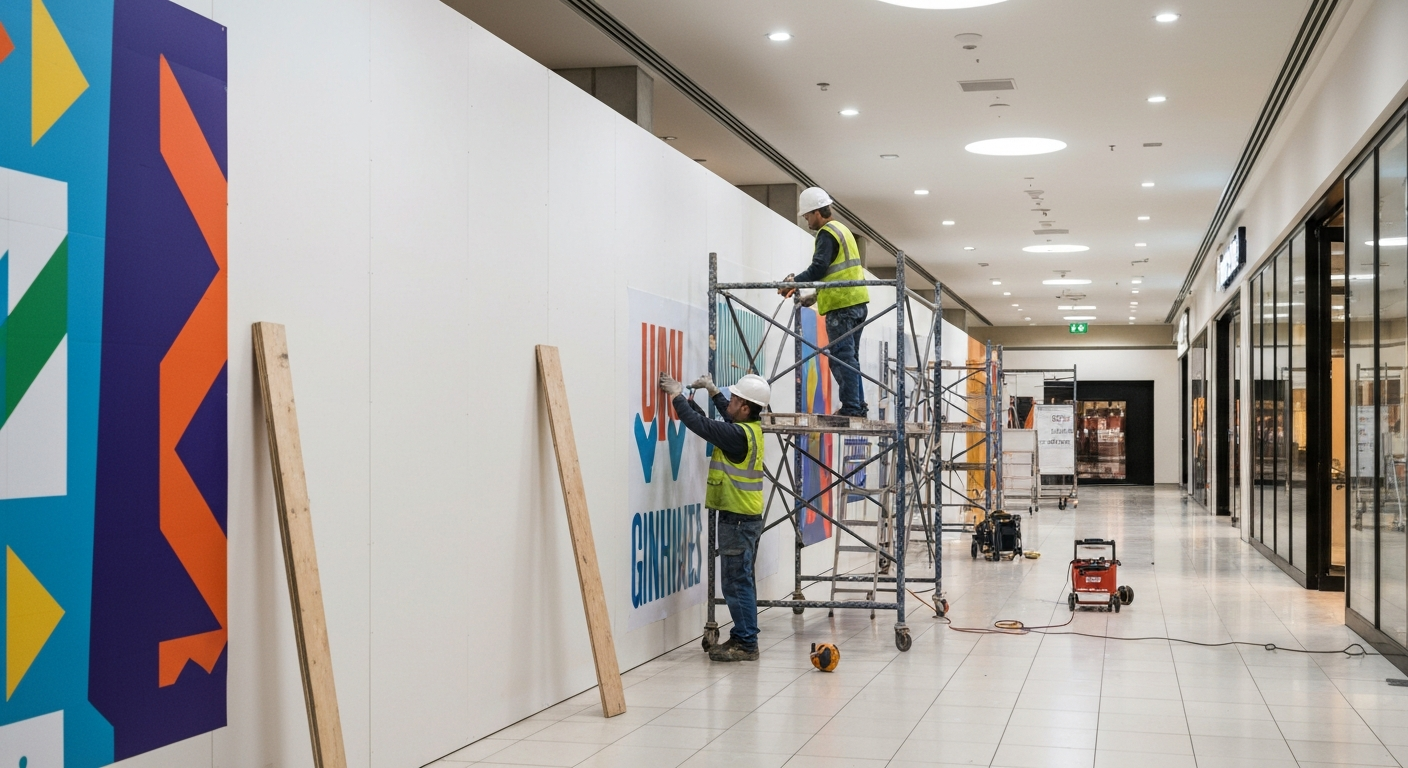
Every retail construction manager has the same instinct the first time a mall hoarding is in scope: "we can't run a saw on the concourse during trading hours." Correct — and that's only the easy half. The harder half is what the overnight install actually looks like, what mall ops needs from your vendor before they'll grant access, and what the difference is between a vendor that runs silent and a vendor that wakes the security desk three times a night.
This guide is the long-form companion to our non-disruptive mall hoarding install reference page. It walks through the full sequence — window planning, vendor credentialing, silent staging, dust and noise containment, photo proof — for retailers, leasing coordinators, and brand managers who have to deliver a finished branded barrier without a single shopper complaint.
1. Book the access window with mall operations
Most enclosed centres require an access request submitted 48–72 hours before the install date. The standard overnight window is 10pm to 6am, anchored to mall closing time on one end and the morning open on the other. The request specifies dock door assignment, freight elevator booking, security escort, and any zone-specific restrictions (food court adjacency, anchor store quiet hours, residential overhead in mixed-use centres).
The cancellation pattern we see most: a vendor confirms install for Wednesday night, the access request was filed Wednesday morning, mall ops can't process it inside their SLA, and the install slips to Thursday — except Thursday is a soft-opening night for the anchor and the dock is locked. One missed window pushes the wall back a full week.
2. Use a vendor already credentialed with the landlord
Vendor credentialing is the single biggest reason an install slot gets cancelled. The landlord requires a Certificate of Insurance (typically $5M general liability naming the landlord and property manager as additional insured), a hot-work permit if any heat-producing process is in scope, WHMIS/SDS sheets for materials, and a documented site-safety plan. First-time vendors take 7–14 days to clear that paperwork. Pre-credentialed vendors clear it on the first access request.
For projects in Simon, Westfield, Brookfield, Macerich, Tanger, Cadillac Fairview, Oxford Properties, Ivanhoé Cambridge, RioCan, or Morguard portfolios, ask any prospective vendor for proof of active credentialing. The cost of switching vendors after a slot is cancelled usually exceeds the price delta that drove the choice.
3. Silent-stage the panels off-site
On-site noise is the second-biggest source of shopper-adjacent complaints (after vendor cancellations). The fix is upstream: every panel is cut, folded, and pre-assembled at the print shop. The on-site work is then either adhesive vinyl application or cordless mechanical fastening — both silent enough that a security guard 30 feet away wouldn't hear it.
Avoid any vendor that needs a circular saw, a panel saw, or a compressor on the concourse. Those are shop tools, not install tools. The reason they show up on the concourse is usually because panels were sized to plans instead of to a laser-measured site survey, and the crew is field-cutting to compensate.
4. Contain dust and protect the concourse
Floor protection rolls out before any tools come off the cart. Adhesive matting at the dock and the freight elevator catches grit before it migrates to the work zone. The work zone itself is cordoned with stanchions so the security escort can see the boundary at a glance. Vacuum extraction handles any minor trimming dust. A cleanup walkthrough with mall ops happens before the crew leaves the floor — not as a verbal sign-off, as a photo handoff.
5. Photo proof before trading hours
The install is not finished when the last panel is on the wall. It's finished when mall ops and the brand team have a photo set in their inbox before 6am: every wall section, every seam, every transition, and the cleaned concourse. Any touch-up is then scheduled into the next overnight window — not pushed into trading hours.
That last detail is the difference between a tenant who can ask for the next overnight slot and a tenant who can't. Mall ops will grant a second window to a vendor that documented the first one cleanly. They won't to a vendor that left them to discover a missed seam during the morning walk.
FAQ
Can a mall hoarding be installed without disrupting shoppers?
Yes. On roughly 85% of mall hoarding projects, the install happens overnight (10pm–6am) when the centre is closed, using pre-staged panels and cordless tools only. Shoppers see a finished branded wall the next morning that wasn't there at close the night before.
What approvals are required for after-hours mall hoarding install?
Certificate of Insurance ($5M general liability naming the landlord), hot-work permit if applicable, vendor credentials on file with the operator, artwork sign-off from mall ops, and a documented site-safety plan. Pre-credentialed vendors clear all five on the first access request.
How does a vendor avoid noise and dust during an overnight mall install?
Panels are cut and pre-assembled at the shop, not on the concourse. On site, install uses adhesive vinyl or cordless mechanical fasteners — no saws, no compressors. Floor protection and adhesive matting at every load-in. Vacuum extraction for any minor trimming.
Need a non-disruptive install scheduled?
Send the centre name, the storefront dimensions, and your target install date. We'll come back inside 24 hours with the overnight window, the access paperwork status, and a fixed line-item quote. The reference page is at non-disruptive mall hoarding install, and the pricing detail is on pricing & turnaround.
Have a hoarding project coming up?
Get a Quote