2026-08-17
Store Opening Sign Options for Mall Retailers: What Works Best on a Hoarding Barrier
By Bryce Mitchell — Founder, Rapid Retail Graphics
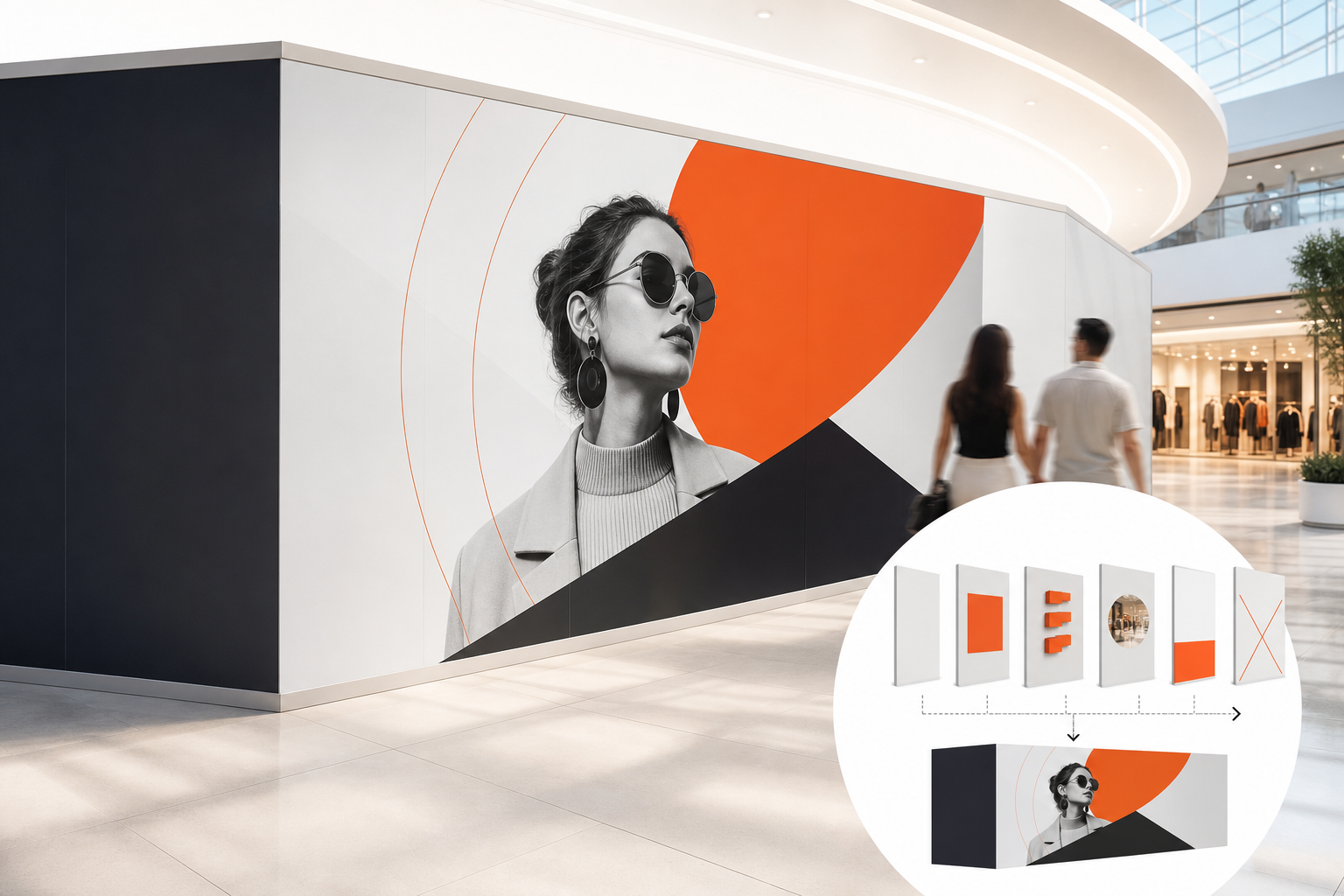
You have a lease signed, a handover date circled, and a construction barrier that will face foot traffic for weeks before your store opens. What goes on that barrier matters more than most retailers expect.
A hoarding barrier is not just a safety requirement. It is the first piece of brand communication your future customers will see at that location. The store opening sign you choose for it sets the tone before a single product hits the shelf.
This article breaks down the main sign options available to mall retailers, what each one does well on a hoarding barrier, and how to decide what fits your project.
Why the Hoarding Barrier Is a Different Canvas
Most retail signage decisions happen inside the store. The hoarding barrier is the opposite: a large, flat, corridor-facing surface in a high-traffic mall, often running 20 to 100 linear feet or more. It sits under mall lighting, surrounded by competing visual noise, and it needs to hold up for weeks without fading, peeling, or looking tired.
That context changes what works. A sign that looks sharp in a window display can disappear on a 40-foot barrier. A material that performs outdoors may not meet mall landlord specifications for interior use. Understanding the construction barrier surface first makes every other decision easier.
It is also worth knowing that landlords like Cadillac Fairview, Oxford Properties, and Ivanhoe Cambridge have their own standards for hoarding graphics. Graphic dimensions, material types, installation methods, and color saturation guidelines can all be part of a landlord approval package. Before committing to a design direction, confirm what your specific landlord allows.
The Main Store Opening Sign Options for a Hoarding Barrier
Full-Panel Vinyl Graphics
This is the most common and most effective option for mall retail hoarding. Large-format vinyl graphics cover the entire barrier surface, turning it into a seamless branded visual rather than a wall with a sign attached to it.
Full-panel graphics work because they scale. A brand campaign image, a product shot, or a lifestyle photograph that might feel cramped at 4 feet wide becomes genuinely impactful at 30 or 40 feet. The barrier stops being a construction obstacle and starts functioning as a billboard-scale brand moment.
Vinyl also accepts high-resolution print at the sizes hoarding requires. When artwork is prepared correctly for the panel dimensions, the result is sharp at normal viewing distances in a mall corridor.
The main consideration is artwork preparation. Campaign files built for digital screens or small-format print need to be adapted for the specific panel layout of the barrier. This is not a simple resize — it involves understanding where panels seam, how images wrap, and how typography reads at distance. A vendor with hoarding-specific design experience handles this differently than a general print shop.
"Coming Soon" Messaging Panels
A dedicated store opening sign panel with a "coming soon" or "opening soon" message is often used alongside full-panel graphics rather than instead of them. It gives shoppers a clear call to action and builds anticipation.
These panels work best when they are integrated into the overall graphic design from the start, not added as an afterthought. A "coming soon" message in a contrasting color block, sized to be readable from 20 feet away, performs better than a small sign tucked into one corner of a large barrier.
If you want to include an opening date, build in flexibility. Retail construction timelines shift. A graphic that says "Opening Spring 2026" ages better than one with a specific date that slips by two weeks.
Branded Dimensional Letters or Logos
Some retailers add dimensional elements to a hoarding barrier: raised letters, a logo cutout, or a backlit sign panel mounted on the graphic surface. These can create visual depth and stand out in a busy corridor.
The practical constraints are real. Dimensional elements add weight and require secure mounting to the barrier structure. They also need landlord approval, which is not guaranteed. Many mall landlords restrict what can be attached to or mounted on a hoarding barrier beyond the approved graphic surface.
If dimensional elements are part of your brand standards, raise this early in the landlord approval process. Do not design around them and then discover they are not permitted.
Window-Style Peekaboo Cutouts
Some hoarding installations include small cutout windows or mesh panels that let shoppers catch partial glimpses of the fit-out in progress. This is a deliberate strategy to build curiosity.
It works well for brands with a distinctive store design, or for food-and-beverage concepts where the sight of an espresso machine or a signature fixture generates genuine interest. It works less well when the construction state is messy or when the interior does not yet reflect the final brand experience.
Peekaboo cutouts also require structural consideration. The barrier needs to support the opening, and cutout placement needs to be factored into the overall graphic layout from the start — which is why an accurate site survey matters before artwork begins.
Temporary Printed Banner Panels
For very short-duration projects or tight budgets, some retailers use banner material rather than adhesive vinyl. Banner panels can be hung or framed rather than applied directly to the barrier surface.
The tradeoff is quality. Banner material at large format does not hold image sharpness the way calendered or cast vinyl does. It can also sag, wrinkle, or shift over time. For a barrier that will be in place for two to six weeks in a high-traffic mall, that visual degradation becomes noticeable.
Most mall landlords also prefer or require specific materials for hoarding graphics. Printed banners may not meet those specifications — our printing and materials overview compares the substrates typically approved for interior mall use.
What Performs Best: A Practical Framework
If you are deciding between these options under a real deadline, here is a straightforward way to think about it.
- For a brand-forward retailer with existing campaign creative: Full-panel vinyl graphics adapted to the hoarding layout is the right choice. The barrier becomes a brand asset, not just a construction requirement. Work with a vendor who can adapt your existing files to the panel dimensions without losing brand integrity.
- For a new concept or first-location opening: Lead with the store opening sign message. Shoppers in that mall do not know your brand yet. A clear "coming soon" message with your brand name and a visual identity introduction does more work than a pure lifestyle image with no context.
- For a food-and-beverage or experiential concept: Consider peekaboo cutouts if your fit-out will be visually compelling in progress. Combine with full-panel graphics on the sections of the barrier where the interior view is not available.
- For a multi-location rollout: Standardize on full-panel vinyl graphics with a consistent template adapted to each site's dimensions. This keeps brand presentation consistent across locations while accommodating the reality that no two hoarding configurations are identical. Rollout management becomes the deciding factor once you are past two or three sites.
The Approval and Installation Variables That Affect Your Choice
The sign option you choose is only part of the decision. How it gets installed — and whether it gets approved — determines whether it actually appears before your opening date.
Mall landlords review hoarding graphic submissions before installation. The review process varies by landlord and property. Some turn around approvals in 48 hours; others take longer. Submitting artwork that does not meet the landlord's specifications means a revision cycle that eats directly into your timeline.
Understanding the differences between retail signage approval and hoarding graphics approval is worth doing before you get deep into design. The rules are not the same, and a non-compliant submission on a construction timeline is more disruptive than it would be for a standard sign permit. The article on retail signage vs. hoarding graphics approval differences covers this in detail.
Installation timing is the other variable. Mall retailers are typically required to install hoarding graphics outside trading hours. This is not optional — it is a condition of the landlord agreement. A vendor without experience coordinating after-hours installation with mall operations and security teams will create friction at exactly the wrong moment in your project. The guide on installing branded construction barriers in a mall without disrupting shoppers covers the logistics in detail.
Working With Your Brand Files
One of the most common friction points in hoarding graphic projects is the gap between what a brand's creative team produces and what a hoarding barrier actually needs.
Campaign files are typically built for specific applications: a web banner, an out-of-home format, a social post. A hoarding barrier has its own dimensions, panel seam locations, and viewing conditions. Adapting existing creative to that format requires someone who understands both the brand standards and the physical constraints of the barrier.
If you are working with a vendor who only handles print production, you may find yourself doing the artwork adaptation internally or bringing in a separate designer. That adds time and introduces the risk of inconsistency between what your brand team approves and what gets printed.
A full-service vendor handles artwork adaptation as part of the project scope — working from your existing files and producing a panel layout that meets both your brand standards and the landlord's specifications before anything goes to print.
Budget Context
Hoarding graphics pricing varies by scope. For a full-panel vinyl installation with print and standard installation included, approximately $6 per square foot is a reasonable benchmark for planning purposes. Final pricing depends on the specific site, barrier dimensions, and project requirements, and is typically confirmed after reviewing site photos and drawings.
For a 200-square-foot barrier, that puts a rough estimate around $1,200 before any site-specific variables. Larger barriers and more complex installs will cost more. If you are budgeting for a multi-location rollout, per-site costs can be estimated more precisely once you have dimensions for each location.
You can get an instant estimate using the pricing calculator.
FAQs
What is the most effective store opening sign format for a mall hoarding barrier?
Full-panel vinyl graphics covering the entire barrier surface typically perform best. They create a cohesive brand presentation at scale and are compatible with most mall landlord specifications. A clear "coming soon" or "opening soon" message integrated into the design adds directional value for shoppers who do not yet know the brand.
Can I use my existing campaign artwork for hoarding graphics?
Yes, but the files need to be adapted for the specific panel layout and dimensions of the barrier. Campaign files built for digital or small-format applications do not simply resize to hoarding scale. A vendor experienced in hoarding graphics will handle this adaptation as part of the project scope.
Do mall landlords have rules about what can go on a hoarding barrier?
Yes. Most major mall landlords, including Cadillac Fairview, Oxford Properties, and Ivanhoe Cambridge, have documented standards covering graphic materials, installation methods, and sometimes design specifications. Submitting artwork that does not meet these standards will result in a revision cycle. Confirm the requirements before finalizing your design.
How long does a hoarding graphic installation typically take?
From site survey to installed graphics, a typical turnaround averages 1 to 5 business days, with rush options available for tighter timelines. The exact timeline depends on project scope, artwork readiness, and landlord approval timing.
Are dimensional letters or raised elements allowed on mall hoarding barriers?
It depends on the landlord and the specific property. Many mall landlords restrict what can be mounted on or attached to a hoarding barrier beyond the approved graphic surface. If dimensional elements are part of your brand standards, raise this during the landlord approval process before finalizing the design.
What happens if my store opening date changes after the graphics are installed?
If your messaging includes a specific opening date and the timeline shifts, the graphic will need to be updated. This is one reason many retailers use "coming soon" or seasonal language rather than a hard date. If a specific date matters to your campaign, confirm your timeline is firm before going to print.
Who coordinates the installation with mall operations and security?
A full-service hoarding graphics vendor handles this directly. Installation is scheduled outside trading hours, and the vendor communicates with mall management and security teams to confirm access and timing. If you are managing this yourself or through a general print vendor, that coordination falls on you.
The store opening sign on your hoarding barrier is working before your store is. Getting the format, artwork, and installation right means that work actually pays off. If you are planning an upcoming opening or renovation and want to understand what your specific barrier needs, Rapid Retail Graphics handles the full scope from site survey through installed graphics, with landlord-standard compliance built into the process — send us your site details to get started.
Have a hoarding project coming up?
Get a Quote