2026-06-22
Full-Service vs. Print-Only Hoarding Graphics: What the Cost Difference Actually Buys You
By Bryce Mitchell — Founder, Rapid Retail Graphics
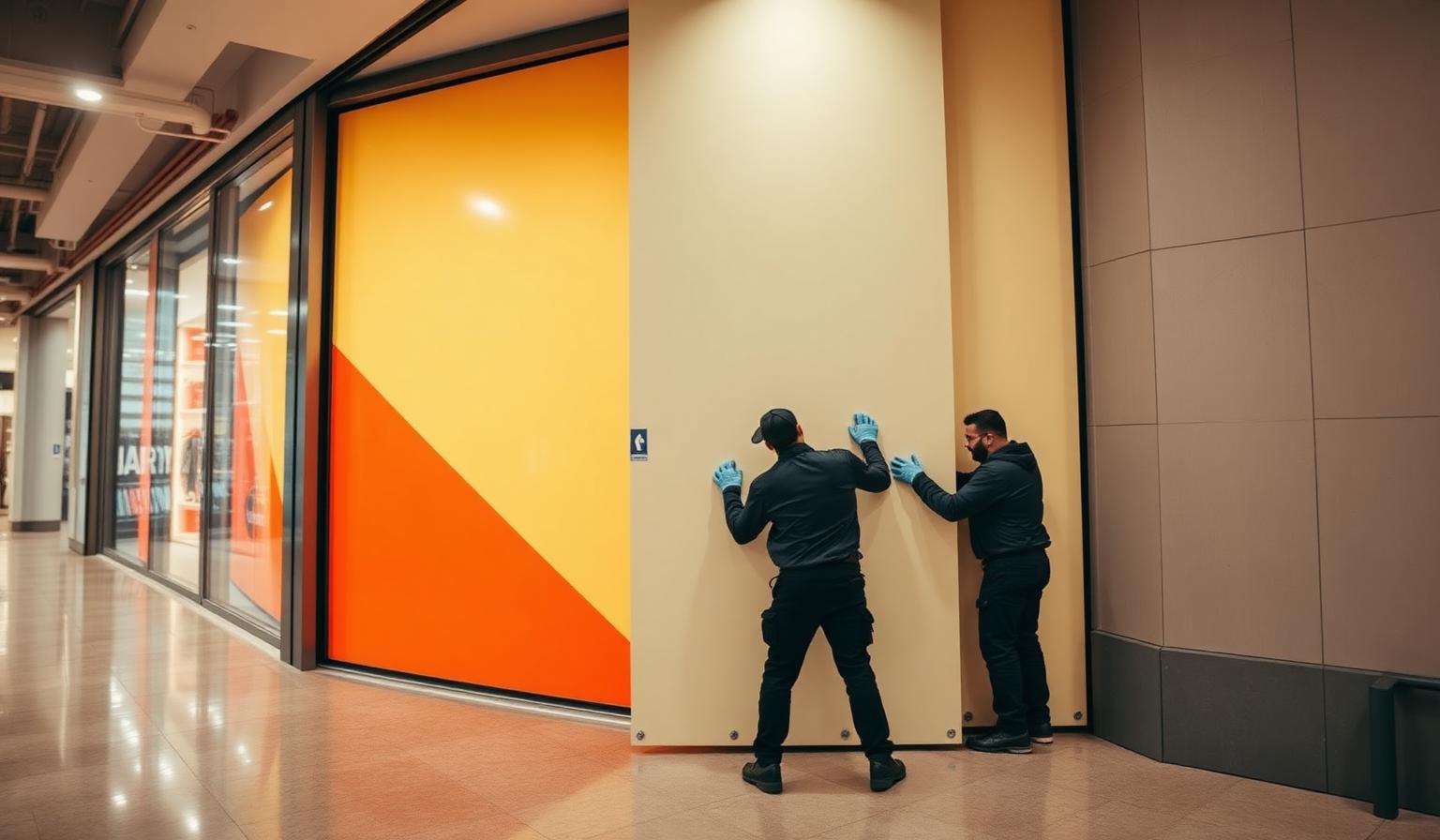
Most hoarding graphics decisions come down to one question: can you get a cheaper price by splitting the work across vendors? The answer is yes. You can find a print shop that will produce panels for less than $6 per square foot. What that price doesn't include is everything that actually gets the job done on time inside a mall.
This article breaks down what you're paying for when you choose full-service hoarding graphics, where print-only arrangements break down, and how to decide which model fits your project.
What Print-Only Hoarding Graphics Actually Covers
A print-only vendor produces the physical panels. That's the entire scope. You supply print-ready files, they output the graphics, and you handle everything else: site measurement, artwork adaptation, delivery logistics, mall operations coordination, and installation.
For a standalone retail location with no access restrictions, print-only can work — if you have the internal capacity to manage what surrounds the print run. For a mall environment, it rarely does.
The failure mode here is underestimating how much work sits outside the print run itself. The panels are typically the fastest part of the project. Everything around them takes longer and carries more risk.
What Full-Service Hoarding Graphics Actually Covers
Full-service means one engagement covers the complete scope: site survey and measurements, artwork production or adaptation, large-format printing, mall operations coordination, and on-site installation.
That distinction matters because each stage has its own failure points. A site survey catches wall configurations, panel break positions, and surface conditions that affect how artwork is laid out. Artwork adaptation ensures your brand files are configured to the actual dimensions of the hoarding — not a generic template. What print-ready artwork actually means for hoarding graphics projects covers this in detail, but the short version is that files built for one format rarely transfer cleanly to another without rework.
Mall operations coordination is the piece most print-only vendors can't touch. Mall ops controls access windows, requires a Certificate of Insurance before scheduling, and sets the conditions under which any contractor can enter the space. A vendor with no history of working inside malls won't know how to navigate that process. The install gets delayed — or it doesn't happen at all.
The Real Cost Comparison
What You Pay in Each Model
At approximately $6 per square foot, full-service hoarding graphics from a specialist like Rapid Retail Graphics includes print and standard installation. That number is transparent and confirmed after reviewing site photos and drawings.
Print-only pricing from a generalist large-format shop might come in at $3 to $5 per square foot for panels alone. On a 200-square-foot hoarding, that looks like a $200 to $600 saving. What that comparison omits:
- Someone on your side has to measure the site accurately, or the panels won't fit
- Artwork adaptation takes time, and errors at this stage mean reprints
- Delivery to the site has to be scheduled and tracked
- Installation requires a qualified crew familiar with mall access protocols
- Mall ops coordination requires documentation, scheduling, and follow-up
If you're a leasing coordinator managing 10 or more tenant transitions per year, that hidden labour compounds fast. The time cost alone often exceeds the apparent price saving.
Where the Risk Concentrates
The failure mode in a fragmented vendor approach isn't that any single vendor is incompetent. It's that no single vendor owns the outcome. When the installer shows up and the panels are 2 inches short because the measurement came from a drawing rather than a site survey, the print shop points to the files you submitted. The installer points to the print shop. Your opening date passes.
Large-format printing for retail: what makes hoarding graphics different from standard signage explains why mall hoarding is a different discipline from standard large-format print work. Mall environments have physical constraints, access restrictions, and brand compliance requirements that generalist printers aren't set up to manage.
When Print-Only Makes Sense
Print-only is a reasonable choice in a narrow set of circumstances:
- You have an in-house project manager with direct experience coordinating mall installs
- Your brand team can produce print-ready files configured to the exact hoarding dimensions
- You have an existing relationship with a qualified installation crew that understands mall access protocols
- Your timeline allows for the coordination overhead across multiple vendors
If all four of those conditions are true, the split-vendor approach is manageable. Most mall marketing directors and leasing coordinators don't have all four in place simultaneously — especially during peak transition periods.
The Timeline Factor
Full-service hoarding graphics from a specialist operates on a 1 to 5 business day lead time from first contact to completed installation. Rush options are available for tighter timelines.
A print-only arrangement doesn't have a comparable lead time because the timeline isn't owned by a single party. The print shop quotes a production window. You arrange delivery. You coordinate with your installer. You handle mall ops paperwork. Each handoff adds time and introduces the possibility of a gap.
For projects tied to a signed lease date or a renovation schedule, that gap isn't a minor inconvenience. Missed opening dates affect landlord relationships and brand reputation in ways that are difficult to recover from quickly.
Hoarding graphics for renovations vs. relocations covers how timeline pressures differ by project type, but the common thread is that both scenarios operate against fixed dates that cannot move.
What Full-Service Accountability Looks Like in Practice
When a full-service vendor owns the scope, accountability is straightforward. One contact manages the survey, the artwork, the print run, and the install. If something needs to be corrected before sign-off, that correction happens within the same engagement — not through a chain of emails to three separate vendors.
For mall marketing directors, this also means photo documentation on completion. You can confirm brand standards were met on-site without being present for the install.
For retail brand managers, the full-service model means your existing files are the starting point. The vendor adapts them to the hoarding dimensions rather than asking you to produce a new set of print-ready files from scratch. Large-format printing for retail hoarding: what you need to know before you order outlines the file requirements in detail if you're preparing assets in advance.
Making the Decision
The cost difference between full-service and print-only hoarding graphics is real. So is the difference in what each model delivers.
If your project is in a mall environment, operates against a fixed date, and requires mall operations coordination, the apparent saving from a print-only approach is almost always offset by the time and risk you absorb. The $6 per square foot full-service rate includes the work that doesn't show up in a print quote but determines whether the install happens on time.
If you're managing multiple tenant transitions per year, the case for full-service is stronger still. The coordination overhead of a fragmented vendor approach scales badly across multiple locations. A single vendor who owns the outcome does not.
Get a quote or use the instant estimate calculator to confirm pricing for your specific project.
FAQs
Have a hoarding project coming up?
Get a Quote