2026-09-30
Construction Hoarding Company: National vs Regional Compared
By Bryce Mitchell — Founder, Rapid Retail Graphics
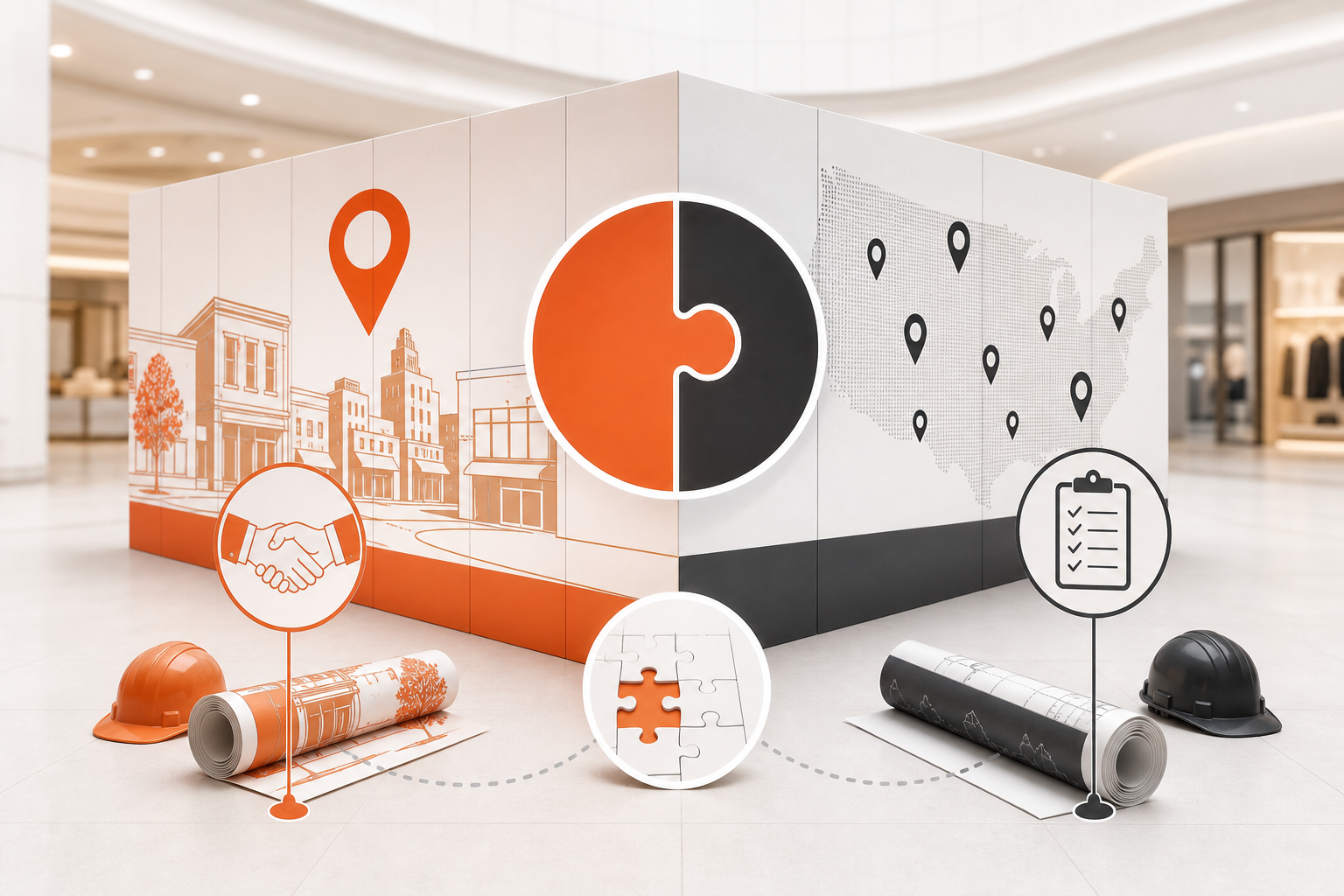
You have a lease signed, a fit-out clock running, and a store opening date that is not moving. The first call you make is to a construction hoarding company. The question is which kind: a regional specialist who knows your market, or a national vendor who can cover every location on your rollout list.
That choice has real consequences. Get it wrong and you are coordinating between a print shop, a separate installer, and a landlord approval process that does not wait for anyone.
This article breaks down what separates national and regional construction hoarding vendors, where each model works, and what to look for when the timeline is tight and the landlord has opinions.
What a Construction Hoarding Company Actually Does
Before comparing scope, it helps to be precise about what full-service hoarding work involves.
A hoarding barrier is the temporary graphic-wrapped enclosure that covers a retail fit-out from lease signing to opening day. It runs along the lease line, faces the mall concourse, and is often the first brand touchpoint a customer sees before the store opens.
A construction hoarding company handles some or all of: site survey and measurement, artwork adaptation to panel layouts, large-format print production, substrate selection, landlord approval documentation, and on-site installation. The coordination between those steps is where most projects run into trouble.
Some vendors stop at print. Others subcontract installation. A few handle the full scope under one roof. Understanding which model you are dealing with matters before you sign anything.
The Regional Specialist Model
Regional hoarding companies tend to know their local market well. They have relationships with specific mall operations teams, understand local permit requirements, and can often respond quickly to a single-location project.
For a one-off store opening in a city where a regional vendor has deep roots, that local knowledge is genuinely useful. They may know the loading dock schedule at a specific mall, or the exact approval format a particular landlord requires.
The limitations show up fast when your program expands.
A regional vendor serving the greater Los Angeles area cannot reliably execute a simultaneous opening in Toronto, Chicago, and Dallas. You can try to stitch together three regional vendors, but then you own the coordination — timelines, artwork consistency, and landlord approval packages across three separate companies. When something slips, that falls to you.
Regional vendors are also more likely to stop at print. Installation is often subcontracted, which adds a handoff and a potential point of failure on the day it matters most.
The National Vendor Model
A national construction hoarding company can take a single brief and execute it across multiple markets without requiring you to manage separate vendor relationships in each city.
The practical benefit is scope compression. One survey process, one artwork adaptation workflow, one approval package format, one installation crew network. A brand manager at a national retailer gets consistent panel layouts whether the opening is in New York or Vancouver. A leasing coordinator at a mall landlord gets one point of contact for the entire program.
The risk with national vendors is inconsistency at the execution level. A franchise network may have national coverage on paper but variable service quality across locations. If the franchise in one city interprets your brand standards differently, or has a slower print queue, the consistency you paid for disappears.
This is why the question is not just national versus regional. It is whether the national vendor has standardized operations or just a national footprint.
Where the Models Break Down
Both models share a version of the same failure mode: the handoff.
Regional vendors hand off between print and installation. National franchise networks hand off between locations. Enterprise-level nationals hand off between account management and execution teams that may never have spoken to each other before your project starts.
Every handoff is a place where the timeline slips, the artwork gets misinterpreted, or the mall operations approval window gets missed.
The fit-out window in a mall environment is not flexible. Mall operations teams at landlords like Cadillac Fairview, Oxford Properties, Simon, and Ivanhoe Cambridge have specific requirements for hoarding installation: after-hours access, security coordination, approval documentation before a single panel goes up. A vendor who has not navigated this before — or who subcontracts installation to someone who has not — creates a compliance risk on a timeline that cannot absorb it.
The Single-Vendor Model as a Third Option
There is a third model that sits between the regional specialist and the large national: a full-service vendor with genuine national coverage and a single-vendor structure from survey through installation.
This model eliminates the coordination gap. Survey, artwork, print, and after-hours installation all sit under one project. No subcontracted installers. No separate print shop. No artwork file sent to a third party and returned adapted incorrectly.
For a leasing coordinator managing a tight opening timeline, the operational difference is significant. You provide location details and dates. The vendor handles the rest — including scheduling installation outside trading hours and coordinating directly with mall operations and security.
For a brand manager running a multi-location program, the benefit is artwork consistency. The same vendor adapts campaign creative to every panel layout, so the visual standard holds across every market.
Rapid Retail Graphics operates on this model, covering store openings, relocations, and renovations across North America. The average lead time from survey to installed graphics runs 1 to 5 business days, with rush options available for tighter windows. Pricing runs at approximately $6 per square foot inclusive of print and standard installation, with final pricing confirmed after reviewing site photos and drawings. You can get an instant estimate.
How to Evaluate Any Construction Hoarding Company
Whether you are looking at a regional shop, a national franchise, or a full-service vendor, the evaluation questions are the same.
Do they handle installation directly, or subcontract it?
Subcontracted installation means a handoff on the day of your opening. Ask specifically who shows up on site and who they report to.
Can they coordinate with mall operations?
This is not a print question. It is a compliance and scheduling question. A vendor who has not navigated after-hours access, security sign-in, and landlord approval packages before is a liability on a non-negotiable timeline.
What is their actual lead time for your market?
A national footprint does not guarantee a fast lead time in every city. Ask for a specific timeline for your location, not a general average.
Can they work from your existing brand files?
Artwork adaptation is a distinct skill from print production. A vendor who can adapt campaign creative correctly to panel dimensions saves a round of revisions and a delay.
Do they have coverage in every market on your list?
For a multi-location program, verify coverage before you commit. A vendor who covers 80 percent of your markets still requires you to find a second vendor for the remaining 20.
If you are evaluating alternatives to larger enterprise vendors, the Craftsmen Industries alternatives guide covers what to look for in a full-service hoarding vendor and where the enterprise model tends to fall short for mid-market programs.
National vs Regional: A Practical Decision Framework
The right choice depends on your program structure.
Single location, familiar market
A regional specialist with a strong local track record can work well, provided they handle installation directly and know the specific mall's operations team.
Multi-location program
Choose a national vendor with standardized operations when consistent brand standards are required. A franchise network with variable quality is not the same thing.
Tight timeline and approval
A single-vendor model with after-hours installation capability is the lowest-risk option. Every handoff you remove is one less potential delay.
Canada-specific programs
Prioritize documented experience with Canadian mall landlords, particularly Cadillac Fairview and Oxford Properties, over learning their requirements on your project.
For more on how national and local print models compare for mall projects specifically, the hoarding printing near me breakdown covers the print side of this decision in detail.
What the Hoarding Barrier Is Actually Doing
One more thing worth stating plainly.
The hoarding barrier is not just a compliance requirement. It is a billboard-scale brand moment on the mall concourse, visible to foot traffic from the day the fit-out starts to the day the store opens. That window can be weeks. Sometimes months.
Mismatched panels, faded graphics, or artwork that does not match the campaign signals the opposite of what the opening is meant to communicate. The construction barrier stops being a neutral placeholder and starts functioning as a brand statement — whether you intended it to or not.
That is the brief. Make sure the vendor you choose can execute it consistently, across every location, on a timeline that does not require you to manage the coordination yourself.
If you are in the early stages of evaluating vendors, What Is Construction Hoarding? A Guide for Retail Property Managers covers the fundamentals of what landlords and leasing teams need to know before a program starts.
FAQs
Have a hoarding project coming up?
Get a Quote